In This Guide
Why SEO billing is its own problem
Most invoicing tools are built for a job with an end: you did the thing, you send the bill, it gets paid. SEO does not work like that. An SEO retainer is the same fee every month, indefinitely, for work whose value is not obvious in any single month.
An open-ended monthly fee creates two problems that generic tools ignore. The first is mechanical: somebody has to raise thirty near-identical invoices on the first, and the month they forget is the month cash flow slips. The second is harder: a client paying $2,000 a month for six months will eventually ask what they are paying for, and rankings alone are a slow answer.
Four things it has to do
Recurring invoices that actually recur. Set the retainer once and have it raised on schedule. If you are duplicating last month invoice, the tool is not doing the job.
A link between the retainer and the work. The strongest answer to what am I paying for is a list of what was delivered this month, sitting next to the invoice. A deliverables list beside the invoice needs the retainer to know which tasks belong to it.
Automatic chasing. Late invoices are the most avoidable cash flow problem in an agency and the one nobody wants to do personally. A tool that sends the reminder removes the awkwardness.
Payment in the client currency. SEO clients are often not in your country. Quoting in a currency the client does not use costs you the exchange spread and looks careless.
The retainer question
Can the tool tell you, without a spreadsheet, whether a client used more of their retainer than they paid for? Answering that without a spreadsheet is the difference between billing software and an invoice generator.
What to avoid
Accounting software as a front end. Accounting software is built for your accountant, not your client, and the client-facing side usually shows it.
Per-seat pricing. An SEO team with contractors gets expensive quickly on a per-user plan.
Anything that cannot take payment where your clients are. Test this with a real card before you migrate.
What it costs
Standalone invoicing is cheap, often under $15 a month, but leaves the retainer and delivery link unsolved. All-in-one agency tools run roughly $9 to $69 a month and include the parts that matter here. Add payment processing fees on top, typically around 2.9% plus a fixed amount per transaction, wherever you collect.
How AgencyKit does it
AgencyKit treats the retainer as the unit rather than the invoice. You define a monthly package of services, the work delivered against it consumes units, and at month end the invoice is raised automatically from what the package covers. Overage is visible rather than absorbed.
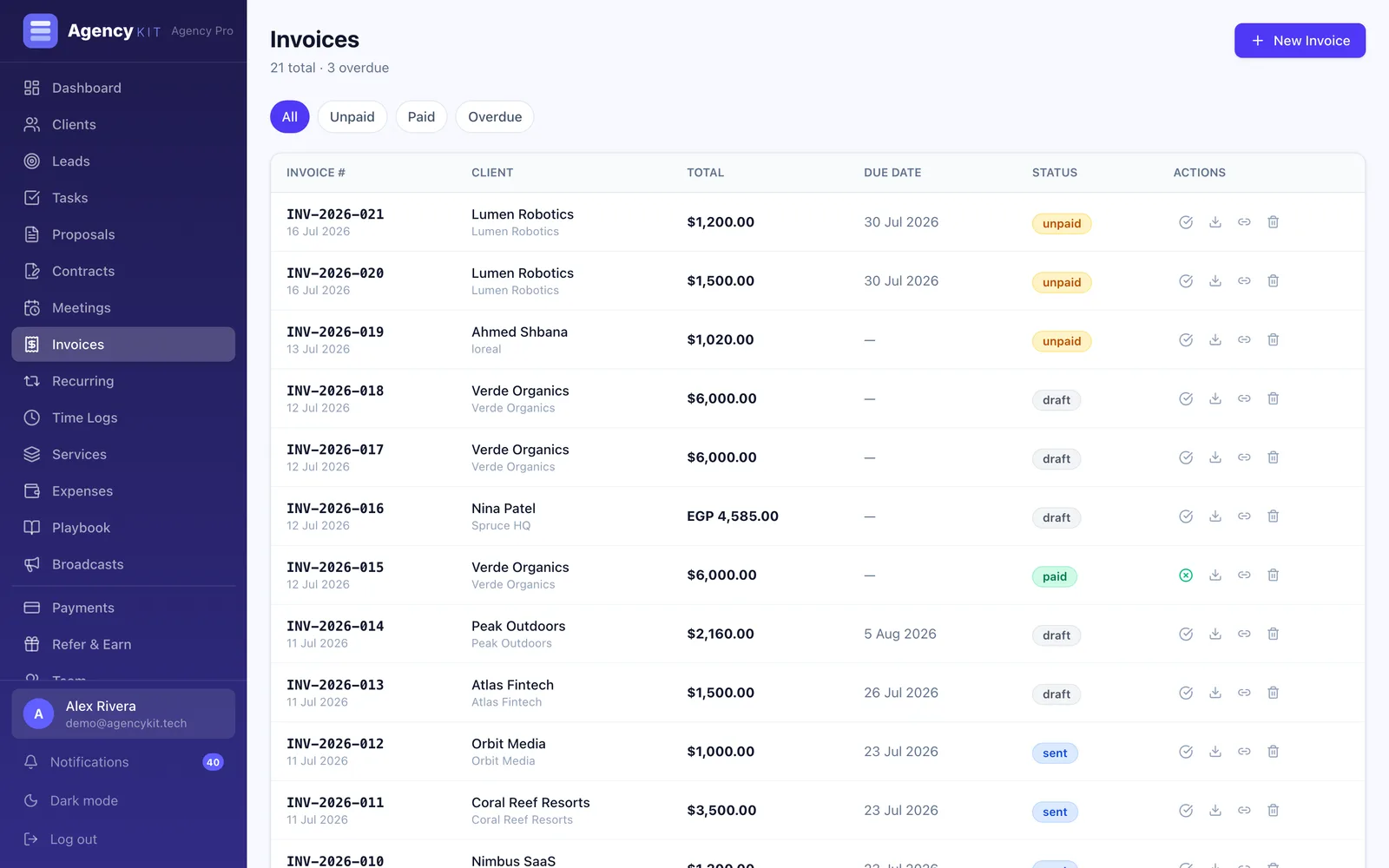
Invoices take payment by Stripe, PayPal or Paymob, chase themselves when overdue, and can be issued in USD, EUR, GBP, EGP, SAR or AED. Clients pay from their branded portal, where the contract they signed sits next to the invoice.
Reports show revenue by client, what is collected against what is still outstanding, and time logged against fee, which is how you find the retainer that stopped being profitable.
Key Takeaways
- SEO billing is recurring by nature, so recurring invoicing is the baseline not a bonus
- Tie the retainer to delivered work or you cannot answer what the client is paying for
- Automatic overdue reminders remove the most avoidable cash flow problem
- Charge in the client currency if your clients are not all in one country
- Expect $9 to $69 a month for an all-in-one, plus payment processing fees
Frequently Asked Questions
The best fit handles recurring retainers rather than one-off invoices, links the retainer to the work delivered so you can show what the fee bought, and chases late payments on its own. Generic invoicing tools cover the first part only. AgencyKit does all three from $9 a month per account and supports six currencies.
Most bill a fixed monthly retainer, sometimes with extra project work invoiced separately. Some bill hourly for consulting or audits, and a minority use performance-based models tied to rankings or traffic. The retainer dominates because SEO results arrive slowly, so both sides prefer a predictable monthly figure over per-deliverable pricing.
Yes, and this is the main reason to use one. A recurring invoice is defined once with an amount and a schedule, and the software raises it each month without anyone remembering. The better tools go further and connect the retainer to the work delivered against it, so the invoice arrives with evidence rather than as a bare number.
Keep the work and the billing in the same system so the delivered items can be listed against the retainer. A client who can see the month deliverables next to the invoice asks fewer questions than one receiving a line that says SEO retainer. In AgencyKit the monthly package tracks consumption, and the client sees it in their portal.
Standalone invoicing tools are often under $15 a month but leave retainer tracking and delivery unsolved. All-in-one agency platforms run roughly $9 to $69 a month. On top of either you pay payment processing, usually around 2.9% plus a fixed fee per transaction. Watch for per-user pricing if you work with contractors.
With some tools yes, and it is worth checking early because many are limited to a short list. Invoicing in the client currency avoids the exchange spread landing on them and looks more professional. AgencyKit supports USD, EUR, GBP, EGP, SAR and AED, and takes payments through Stripe, PayPal and Paymob.
Reading this in Google? You can tell it to show AgencyKit to you more often.
References
- AgencyKit client portal, contracts and invoicing (2026). agencykit.tech
- AgencyKit pricing, billed per account (2026). agencykit.tech
- AgencyKit retainers and monthly packages (2026). agencykit.tech