Why Your Rate Is Not Your Salary Divided by Hours
The most common way freelancers set a rate is to take the salary they want, divide it by 2,080 (a full-time work year), and call that their hourly rate. It feels logical. That method is also how a lot of freelancers end up underpaid and confused about why the money never adds up.
Two things break that maths. First, you are not billing 40 hours a week. A big chunk of your week goes to admin, sales, invoicing, and finding the next client, none of which a client pays for. Second, an employee salary hides a lot of costs your employer used to cover: software, equipment, insurance, taxes, unpaid time off. As a freelancer, your rate has to carry all of it.
Your billable rate is not what you want to earn per hour. Your billable rate is the number that, across the hours you can actually bill, covers what you want to earn plus everything it costs to run your business.
The Billable Rate Formula
The version that actually holds up: Work it out per year, then divide by the hours you can realistically bill.
Each piece means:
- Target income is the take-home pay you want for the year.
- Business costs are everything it takes to operate: software, hardware, insurance, subscriptions, a co-working desk, professional fees.
- Tax buffer is the slice you set aside for tax. The tax buffer varies by country, so use your own rate, but do not leave it out.
- Billable hours a year is the honest number of hours you can actually charge for, not the number you sit at your desk.
A Worked Example
Say you want to take home $70,000 a year. Your business costs run to $8,000, and you set aside 25% for tax. Now for the part most people get wrong: billable hours.
There are about 2,080 working hours in a year. Take off holidays, sick days, and public holidays (call it 6 weeks, roughly 240 hours). Of the roughly 1,840 hours left, maybe 60% are actually billable, because the rest go to running the business. That is about 1,100 billable hours a year.
Now the maths:
- Target income + costs = $70,000 + $8,000 = $78,000
- Add a 25% tax buffer: $78,000 ÷ 0.75 = $104,000 you need to bill
- Divide by billable hours: $104,000 ÷ 1,100 = about $95 an hour
That $95 is a long way from the "$70,000 ÷ 2,080 = $34 an hour" the naive method gives you. Same target income, nearly triple the rate, and the higher one is the number that actually gets you to $70,000 in the bank.
Round up, do not round down
Once you have your number, round it up to something clean and confident ($95 becomes $100). A slightly higher rate rarely loses good clients, and it gives you room for the odd write-off or discount without going underwater.
Billable vs Non-Billable Hours (and Utilization)
The single biggest lever in that formula is your billable hours, and it is the one people guess at. The ratio of billable hours to total hours is your utilization rate. If you bill 1,100 of 1,840 working hours, you are about 60% utilized, which is normal and healthy for a solo freelancer. Chasing 90% usually means you are not spending enough time on sales, and the pipeline dries up.
You cannot manage what you do not measure. If you have never tracked where your hours actually go, your billable number is a guess, and a guess in this formula quietly sets your rate too low. Tracking your time for even a few weeks turns that guess into a real number.
When (and How) to Raise Your Rate
Recalculate at least once a year, and raise your rate when any of these is true: you are booked solid, your costs have gone up, your skills have clearly grown, or the maths says your current rate no longer hits your target. Raising it is simpler than it feels. Tell existing clients ahead of their next project or renewal, quote the new rate to every new client from today, and do not apologise for it. A rate is a price, not a personal ask.
Track It, Then Bill It
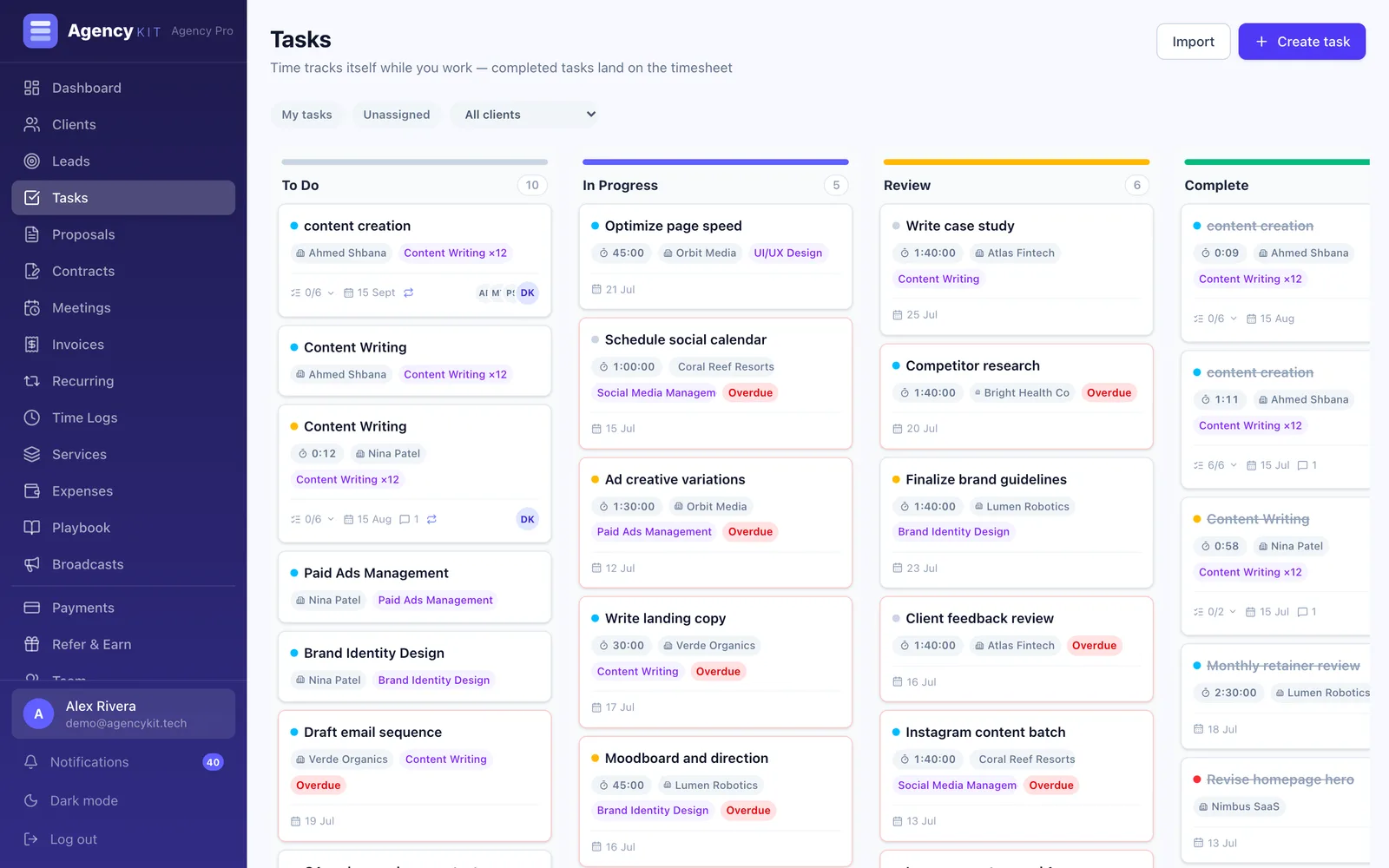
A rate only works if you can see your real billable hours and turn them into invoices without friction. With AgencyKit you run a one-click timer per client and task, so your billable hours stop being a guess, and you can turn tracked time straight into an invoice at your rate. For a quick starting point, the free rate calculator runs the formula above for you.
Wrapping Up
Your billable rate is not your dream salary split across the hours in a year. Your billable rate is what you need to bill, across the hours you can actually charge for, to cover your income, your costs, and your tax. Run the real formula, be honest about your billable hours, round up, and revisit it every year. That one calculation is the difference between busy and profitable.
Once your rate is set, protect it: read how to stop scope creep so unpaid extras do not drag your effective rate back down, and how to turn tracked time into an invoice.
Key Takeaways
- Your billable rate is not your target salary divided by 2,080 hours. That method leaves most freelancers underpaid
- The real formula: (target income + business costs + tax buffer) divided by the hours you can actually bill in a year
- The biggest variable is billable hours. Around 60% of your working hours being billable (your utilization) is normal and healthy
- A worked example: wanting $70,000 with $8,000 of costs, 25% tax, and 1,100 billable hours works out to about $95 an hour, not $34
- AgencyKit tracks your real billable hours with a one-click timer and turns them straight into invoices, and its free rate calculator runs the formula for you
Frequently Asked Questions
Add the income you want, your yearly business costs, and a tax buffer, then divide by the hours you can actually bill in a year. For example, if you want $70,000, have $8,000 of costs, set aside 25% for tax, and can bill about 1,100 hours, you need to bill roughly $104,000 across those hours, which is about $95 an hour.
Billable hours are the hours you can actually charge a client for. Billable hours are a subset of the hours you work, because a big part of your week goes to admin, sales, invoicing, and finding new clients, none of which a client pays for. For most solo freelancers, roughly 60% of working hours end up billable.
Because your rate has to cover everything an employer used to pay for on top of the salary: software, equipment, insurance, taxes, and unpaid time off, all spread across fewer billable hours. A rate that simply matches an employee wage divided by full-time hours leaves you underpaid once those costs come out.
Around 60% is normal and healthy for a solo freelancer, meaning about 60% of your working hours are billable. Chasing 80% or 90% usually means you have stopped spending enough time on sales and marketing, which dries up your pipeline. Use your real utilization in the rate formula rather than assuming you bill every hour.
Recalculate at least once a year, and raise your rate when you are booked solid, your costs rise, your skills clearly grow, or the maths shows your current rate no longer hits your target. Tell existing clients before their next project or renewal, and quote the new rate to every new client straight away.
Calculating a solid hourly rate is worth doing either way, because it is the basis for pricing fixed-fee work too. Estimate the hours a fixed project will take, multiply by your rate, and add a buffer for the unexpected. Many freelancers quote a fixed price to the client but price it internally from their hourly rate.
Reading this in Google? You can tell it to show AgencyKit to you more often.
Sources & References
- U.S. Bureau of Labor Statistics, work hours and self-employment data. bls.gov
- Freelancers Union & Upwork, freelance rates and earnings research. freelancersunion.org
- AgencyKit time tracking & rate calculator (2026). agencykit.tech