What Is a Marketing Agency Scope of Work?
A scope of work for a marketing agency defines exactly what the agency will deliver across every channel it manages, and what it will not. Because agency work usually spans several channels at once, SEO, content, paid ads, email, the scope is where you draw clear lines around each one. Without it, a client who is paying for SEO and content starts assuming ads and a new website are included too, and the retainer quietly loses money.
The scope also does something a proposal deck cannot: it protects the relationship. When results are involved, the difference between committing to deliverables and promising outcomes is enormous, and the scope is where you make that distinction in writing.
The Free Marketing Agency Scope of Work Template
A full multi-channel agency scope you can copy and adapt: The template breaks deliverables down per channel, keeps ad spend separate, and handles the tricky question of goals versus guarantees. Replace everything in [brackets].
2. Channels and services. The Agency manages [SEO, content, paid ads, email marketing] and provides strategy, execution, and reporting for each.
3. Monthly deliverables. Set out per channel, for example:
• SEO: [technical fixes, 2 optimized pages, monthly rank tracking].
• Content: [4 articles up to 1,500 words].
• Paid ads: [campaign setup, management, and optimization across Google and Meta].
• Email: [2 campaigns per month, built and sent].
• Strategy: [one monthly plan and one review call].
4. Ad spend and third-party costs. The fee covers management only. Ad spend, software, and subscriptions are [billed separately / paid directly by the Client] and are not marked up unless agreed in writing.
5. Goals and reporting. Agreed targets are directional, not guaranteed. The Agency commits to the deliverables and effort above, since final results depend on factors outside its control. A monthly report covers [the agreed KPIs].
6. Account management and approvals. A dedicated account manager ([role]) is the point of contact. Requests go through [one channel]. Work is shared [5] days ahead and approved within [2] business days.
7. Out of scope. Ad spend and third-party tools, website development, creative and video production, PR, and any channel not listed above. These are quoted separately.
8. Client responsibilities. Access to ad accounts, analytics, and the website; brand assets; product information; and timely approvals.
9. Fees and term. [$X,XXX] per month, with a [3] month minimum, then continuing monthly with [30] days notice to cancel.
Signed: [Agency] __________ [Client] __________ Date: __________
Commit to deliverables, not to outcomes you cannot control
The most dangerous line in agency work is an implied guarantee. Rankings, ad performance, and revenue depend on the market, the product, and the budget, none of which you fully control. Commit clearly to the deliverables and the effort, state that targets are directional, and you protect yourself from being blamed for forces outside your hands.
Why Multi-Channel Scopes Need Extra Care
A marketing agency scope has to manage a few things a single-service scope does not.
Deliverables per channel. Break the work down channel by channel with real numbers, so a client can see exactly what their fee buys in SEO versus content versus ads. A vague "full-service marketing" line is an invitation to endless assumptions.
Ad spend and pass-through costs, kept separate. Just like social work, the fee is for management, and the ad budget plus any software costs are the client's, billed separately. Say whether you mark them up, and never let the ad budget blur into your fee.
Goals versus guarantees. Be explicit that agreed targets are directional and that you commit to deliverables and effort. The goals-not-guarantees clause prevents most agency disputes, because it sets the right expectation before results are measured.
Access and dependencies. Agency work stalls without access to accounts and analytics, and without timely approvals. List the client's responsibilities so a delay on their side does not become a failure on yours.
Turn the Scope Into a Signed Retainer
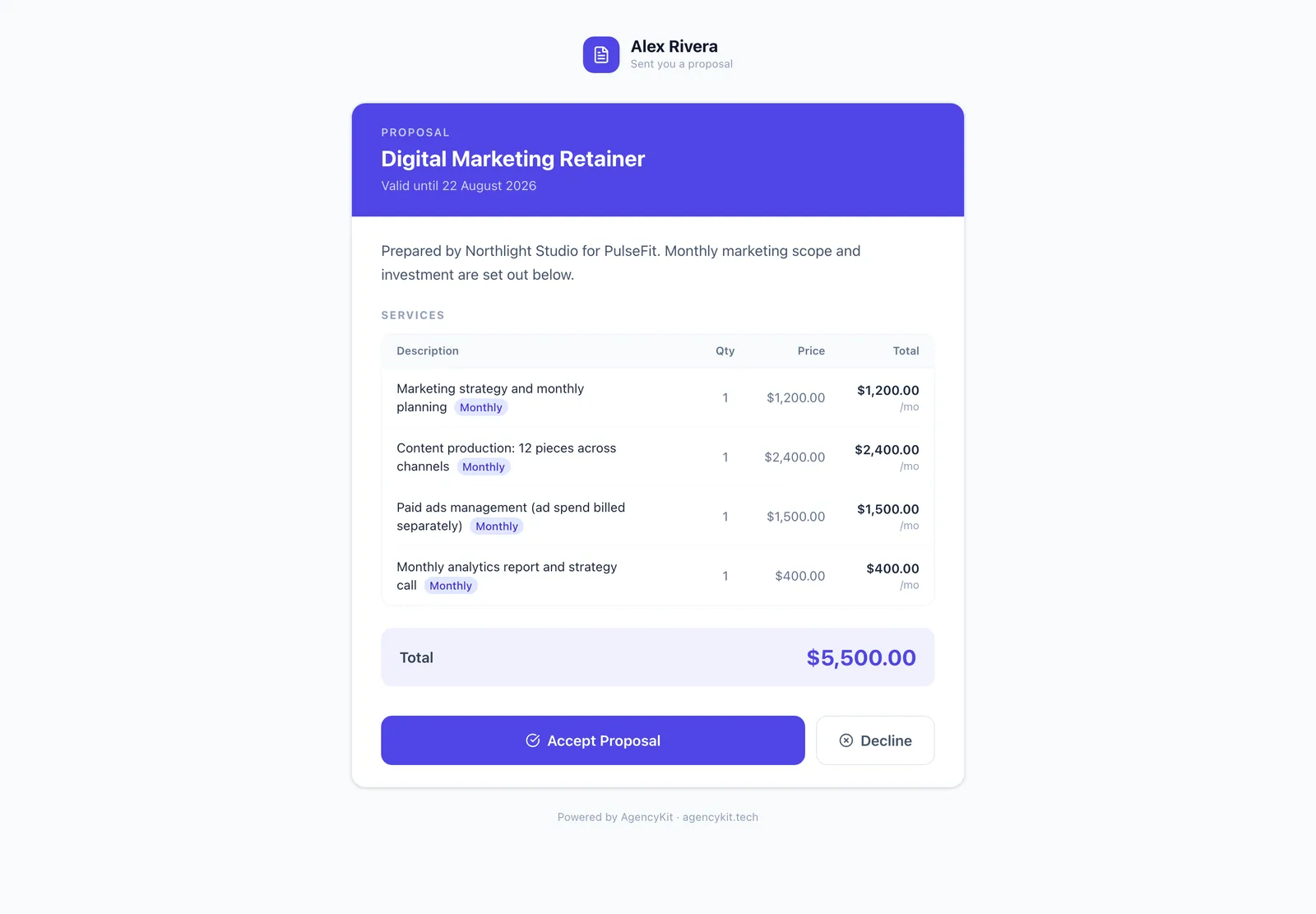
An agency scope earns its keep once it is signed and billing every month. In AgencyKit, you present the scope as a branded proposal the client accepts online, it becomes a contract, and the monthly fee runs as a retainer that invoices automatically. Your team works the account from tasks and a client portal, and because pricing is per account, the whole team is covered as you grow. See AgencyKit for agencies.
Wrapping Up
A marketing agency scope of work keeps a multi-channel retainer profitable and the relationship healthy. Break deliverables down per channel with real numbers, keep ad spend and tool costs separate from your fee, commit to deliverables rather than guaranteed outcomes, and list the access and approvals you need from the client. Then present it as a proposal they sign and a retainer that bills itself. Copy the template, set your terms, and run the agency on clear, signed scopes.
Next, set the commercial terms with the marketing agency retainer agreement template, and see how to stop scope creep.
Key Takeaways
- A marketing agency scope breaks deliverables down per channel (SEO, content, ads, email) with real numbers
- Keep ad spend and third-party tool costs separate from the management fee, stated explicitly
- Commit to deliverables and effort, not guaranteed outcomes: state that targets are directional
- List the client’s access and approval responsibilities so their delays do not become your failures
- Present the scope as a branded proposal the client signs, then bill it as a retainer that invoices automatically
Frequently Asked Questions
A marketing agency scope of work defines exactly what the agency delivers across the channels it manages, such as SEO, content, paid ads, and email, and what it does not. A good scope breaks the deliverables down per channel with real numbers, keeps ad spend separate from the management fee, sets the reporting and approvals, and states that agreed targets are directional rather than guaranteed outcomes.
Name the channels and services; list monthly deliverables per channel in real numbers; keep ad spend and third-party tool costs separate from the fee; state that targets are directional and that you commit to deliverables and effort, not guaranteed results; set the reporting, the account manager, and the approval workflow; list the client’s access responsibilities; and set the fee, minimum term, and notice period.
Keep it entirely separate from your management fee. The scope should state that the fee covers strategy and management, while ad spend and any software or subscription costs are the client’s, either billed separately or paid directly by them, and not marked up unless agreed in writing. Blurring ad budget into the fee is one of the most common and damaging agency billing disputes.
No, and the scope should make that clear. Rankings, ad performance, and revenue depend on the market, the product, the budget, and competition, none of which an agency fully controls. Commit to the deliverables and the effort, and state that agreed targets are directional. Committing to deliverables rather than targets protects you from being blamed for forces outside your hands, and sets the right expectation before results are ever measured.
The scope of work lists what the agency delivers each month across its channels. The retainer agreement sets the commercial terms around those deliverables: the fee, ad-spend handling, minimum term, scope changes, and cancellation. Keeping them as two documents lets you adjust the channel deliverables without rewriting the whole agreement, and it keeps the client clear on which document covers what.
Typically ad spend and third-party tool costs, website development, creative and video production, PR, and any marketing channel not named in the scope. Listing these explicitly is what protects the retainer, because it turns every extra request, like adding a new channel or building a landing page, into a clear, separately quoted decision rather than an assumed inclusion that erodes your margin.
Three months is a common minimum, and some agencies use six for work like SEO that takes longer to show results. A minimum term protects the ramp-up: onboarding, audits, setup, and campaigns that need time to optimize. A minimum term also filters for clients who are committed. After the minimum, the retainer usually continues month to month with a notice period on both sides.
Turn it into a clear, branded proposal that itemizes each channel and its deliverables with pricing, so the client sees exactly what they are buying. Itemising each channel makes the value and the price easy to understand. In an all-in-one tool the accepted proposal flows into a contract and a recurring retainer invoice, so the scope, the signature, and the monthly billing all connect without re-keying anything.
Reading this in Google? You can tell it to show AgencyKit to you more often.
Sources & References
- U.S. Small Business Administration, contracts and scope guidance. sba.gov
- AgencyKit proposals, contracts, retainers & client portal (2026). agencykit.tech
- AgencyKit for agencies (2026). agencykit.tech