What Is a Social Media Agency Scope of Work?
A scope of work for a social media marketing agency is the document that defines exactly what the agency delivers for a client each month, and what it does not. An agency scope is more involved than a solo social media manager's, because an agency usually bundles several services, works as a team with an account manager, runs paid campaigns, and reports under a brand. Getting all of that pinned down in writing is what keeps a retainer profitable instead of slowly drowning in unbilled requests.
For an agency, the scope is also a sales tool. A clear, itemized scope shows a prospective client exactly what they are buying, which makes the price easier to justify and the relationship easier to manage once it starts.
The Free Social Media Agency Scope of Work Template
A full agency scope you can copy and adapt: The template covers the extra pieces a solo scope does not: multiple services, a named account manager, paid social, and white-label reporting. Replace everything in [brackets].
2. Services and platforms. The Agency manages [Instagram, TikTok, LinkedIn] and provides: content production, community management, [paid social management], and monthly strategy.
3. Monthly deliverables.
• Content: [20] feed posts and [30] stories per month across the platforms above, in [static, carousel, and short-form video].
• Community management: replying to comments and DMs, up to [10] hours per week on business days.
• Paid social: campaign setup, management, and optimization ([ad spend is billed separately, paid by the Client]).
• Strategy and reporting: one monthly content plan, one performance report, and one [30] minute review call.
4. Team and point of contact. A dedicated account manager ([role]) is the Client's single point of contact. Requests are made through [one agreed channel].
5. Approval workflow. Content is shared [7] days before scheduling. The Client approves or requests changes within [2] business days. Content not reviewed in time is published as drafted.
6. Reporting and white-label. Monthly reporting covers [reach, engagement, follower growth, and paid results], presented under the [Agency / Client] brand.
7. Out of scope. Ad spend, influencer fees and contracts, photo or video production, website or blog content, and any platform not listed above. These are quoted separately.
8. Client responsibilities. Brand assets, product information, ad account and page access, and approvals delivered on time.
9. Fees and term. [$X,XXX] per month, with a [3] month minimum, then continuing monthly with [30] days notice to cancel.
Signed: [Agency] __________ [Client] __________ Date: __________
What an Agency Scope Needs That a Solo One Does Not
If you run an agency, a few sections deserve extra care because they are where agency work differs from a freelancer's.
Services, bundled and named. Agencies rarely sell just posting. Spell out each service line (content, community management, paid social, strategy) so the client sees the full value and cannot assume an unlisted service is included.
Paid social and ad spend, kept separate. Paid social and ad spend are the single biggest source of confusion in agency social work. State clearly that your fee covers managing the campaigns, while the ad spend itself is the client's money, billed separately or paid directly by them. Never let the two blur together.
A single point of contact and one channel. Agencies get killed by requests coming from five people across three channels. Name the account manager and the one channel for requests, so work is tracked and nothing gets lost in a DM.
White-label reporting. If you present under your own brand or the client's, say so. It matters for agencies that resell or that manage a client's own presence, and it belongs in the scope so expectations are set.
Set a minimum term for agency retainers
Agency social work takes a ramp-up: audits, account access, content pipelines, and paid campaigns that need weeks to optimize. A three-month minimum term protects that investment and weeds out clients who expect miracles by week two. Put it in the scope and the retainer, not just in conversation.
Turn the Scope Into a Signed Retainer
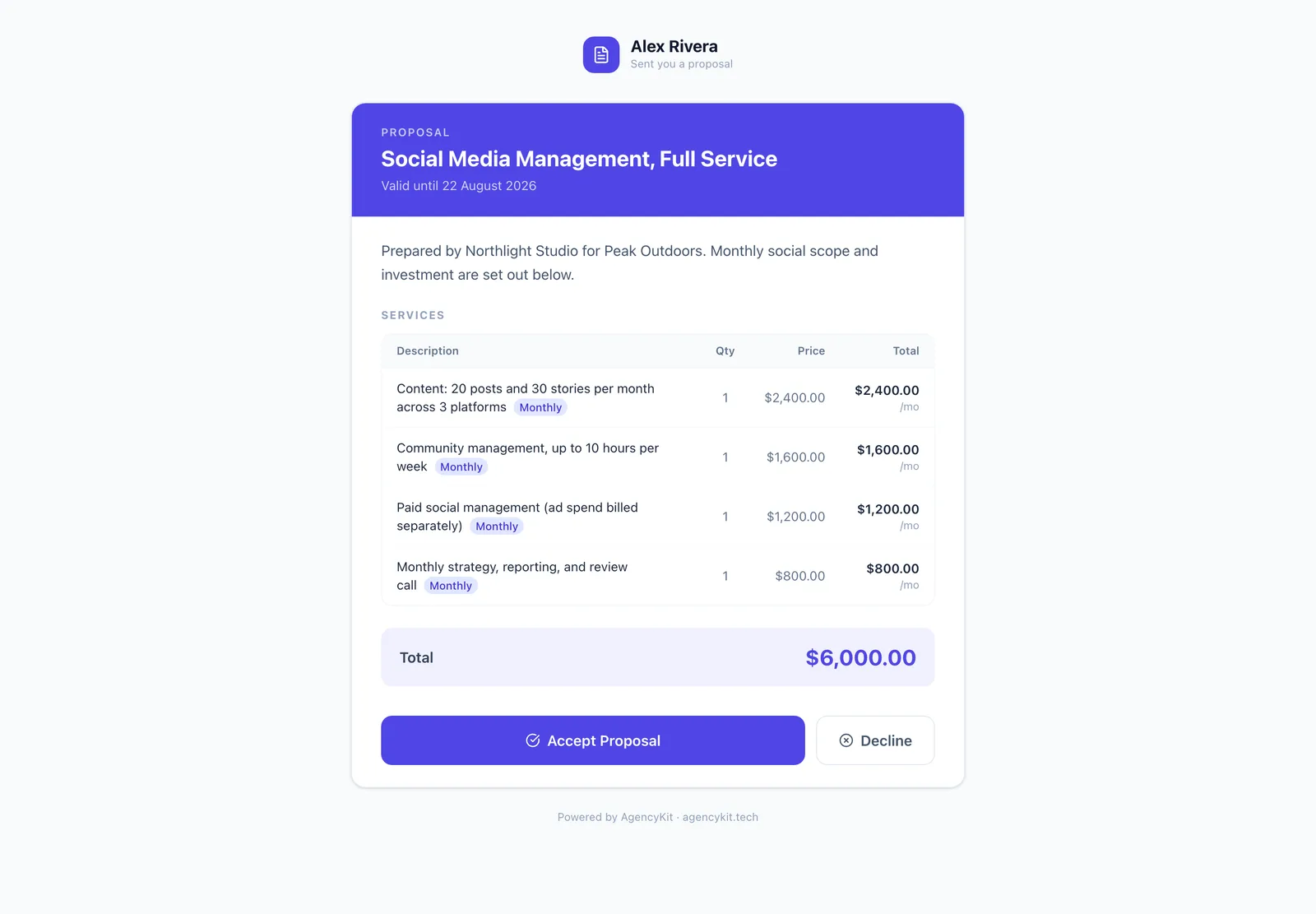
An agency scope only pays off when it is signed and billing. In AgencyKit, you present the scope as a branded proposal the client accepts online, it flows into a contract, and the monthly fee becomes a retainer that invoices automatically. Your team works from a shared client portal where the client approves content, and the whole account, from proposal to paid, lives in one place. See AgencyKit for agencies.
Wrapping Up
A social media agency scope of work is the backbone of a healthy retainer. Bundle and name your services, keep ad spend separate from your fee, set a single point of contact, define the approval workflow, and put everything else out of scope. Add a minimum term to protect the ramp-up. Then present it as a proposal the client signs and a retainer that bills itself. Do that and the agency grows on predictable revenue instead of scattered, unbilled work.
Next, lock in the commercial terms with the agency retainer agreement template, and see how to stop scope creep.
Key Takeaways
- An agency scope of work is more involved than a solo one: it covers bundled services, a team, an account manager, and often paid campaigns
- Keep ad spend completely separate from your management fee, stated explicitly, to avoid the most common agency billing dispute
- Set a single point of contact and one request channel so work is tracked and nothing gets lost
- Add a three-month minimum term to protect the ramp-up investment agency social work requires
- Present the scope as a branded proposal the client signs, then bill it as a retainer that invoices automatically
Frequently Asked Questions
A social media agency scope of work defines exactly what the agency delivers for a client each month: the bundled services (content, community management, paid social, strategy), the platforms, the deliverable counts, the approval workflow, reporting, and what is out of scope. An agency scope is more detailed than a solo social media manager scope because it covers a team, an account manager, and often paid campaigns.
Name the platforms and each service line, state monthly deliverables in numbers (posts, stories, community-management hours), define the paid social arrangement with ad spend kept separate, set a single point of contact and one request channel, describe the content approval workflow and reporting (including whether it is white-labelled), list what is out of scope, and set the fee, minimum term, and notice period.
Keep it completely separate from your management fee. The scope should state that the agency fee covers setting up and managing campaigns, while the ad spend itself is the client’s money, either billed separately or paid directly by the client to the platform. Blurring the two is the biggest source of billing disputes in agency social work, so make the split explicit.
Yes, a minimum term of around three months is standard and wise. Agency social work has a real ramp-up: audits, account access, building a content pipeline, and paid campaigns that need weeks to optimize. A minimum term protects that upfront investment and filters out clients expecting instant results. After the minimum, the retainer usually continues month to month with notice.
An agency scope covers more: bundled service lines rather than just posting, a named account manager and single request channel, paid social management, and white-label reporting. A solo scope is simpler, usually one or two platforms and a set post count. The core idea is the same, defining deliverables in numbers, but an agency scope has to manage a team and multiple services.
Turn it into a clear, branded proposal the client can review and accept online, with the services itemized and priced. Itemising and pricing each service makes the value obvious and the price easier to justify than a plain document. In an all-in-one tool the accepted proposal flows straight into a contract and a recurring retainer invoice, so the scope, the signature, and the billing all connect without re-keying.
Typically: ad spend, influencer fees and contracts, photo and video production or shoots, website and blog content, and any platform not named in the scope. Listing these out explicitly is what protects the retainer, because it turns every extra request into a clear, separately quoted decision rather than an assumed inclusion that eats your margin.
Set a defined workflow in the scope: share content a set number of days ahead, give the client a fixed window (often two business days) to approve or request changes, and state that content not reviewed in time is published as drafted. Using a client portal where the client approves content in one place, rather than scattered email and DMs, keeps approvals fast and tracked.
Yes, and the difference is not length. An agency scope has to name which of your people does what and how work moves between them; a solo social media manager template does not, because there is one person. What a solo scope needs more of is the boundary: how many revisions, how fast you reply, what happens on weekends, and what is billed separately. Agencies absorb small extras across a team, and a single person absorbs them out of their own evening.
Reading this in Google? You can tell it to show AgencyKit to you more often.
Sources & References
- U.S. Small Business Administration, contracts and scope guidance. sba.gov
- AgencyKit proposals, contracts, retainers & client portal (2026). agencykit.tech
- AgencyKit for agencies (2026). agencykit.tech