What Is a Retainer Agreement?
A retainer agreement is a contract where a client pays a set fee on a recurring basis, usually monthly, to reserve your services or a fixed amount of work. Instead of quoting each project on its own, you and the client agree on an ongoing scope and a flat monthly fee. The client gets guaranteed access and priority. You get income you can actually plan around.
For a freelancer or a small agency, a retainer is one of the most valuable things you can set up. A retainer smooths out the feast-or-famine swings of project work, takes some of the pressure off the constant search for the next client, and turns a good client into a steady line of monthly revenue.
The Two Types of Retainer (Access vs Work)
Almost every retainer is one of two kinds, and being clear about which one you are selling heads off most disputes.
1. Pay-for-access (availability retainer)
The client pays to have you on call, to guarantee your availability and priority when they need you, whether or not they use all the time in a given month. An access retainer suits advisers, consultants, and specialists whose value is being reachable. The fee covers reserved capacity, so unused time normally does not carry over.
2. Pay-for-work (deliverables or hours retainer)
The client pays for a defined amount of work each month: a set number of hours, or a fixed list of deliverables like "12 social posts and a monthly report". A deliverables retainer is the common one for designers, developers, marketers, and agencies. The scope is spelled out, and anything past it is billed as overage.
Name the type
The biggest cause of retainer friction is a client treating a pay-for-access retainer like unlimited pay-for-work. Say which type it is, spell out the scope, and state what happens to unused time and overage. In writing.
How Retainer Agreements Work
A typical retainer runs like this:
- You and the client agree the monthly scope and fee.
- You sign a retainer agreement that sets out the scope, fee, term, and the rules for unused time and overage.
- The client is invoiced the fee in advance, at the start of each month.
- You deliver the agreed work through the month, tracking hours or deliverables against the scope.
- Anything beyond the scope is billed as overage, and the retainer renews on its own until someone cancels with notice.
Billing in advance is what makes a retainer so good. You are paid before you do the work, which is the exact opposite of chasing an invoice after you deliver.
What to Include in a Retainer Agreement
A good retainer agreement is short but specific. Make sure yours covers:
- Scope of services: exactly what is included each month (hours or deliverables), and what is not.
- Retainer fee and billing date: the amount, and that it is due in advance.
- Term and cancellation: month to month or fixed term, and the notice period (30 days is standard).
- Unused time: whether hours roll over or are lost at the end of the month.
- Overage: the rate for work beyond the scope, agreed up front.
- Payment terms and late fee: see our payment terms guide.
- Ownership: when rights to the work pass to the client, usually on payment.
Free Retainer Agreement Template
A simple, plain-English retainer agreement you can copy and adapt: Treat it as a starting point, not legal advice, and have a lawyer look it over for high-value or complicated deals.
This Retainer Agreement ("Agreement") is made on [date] between [Your Name / Business] ("Provider") and [Client Name / Company] ("Client").
1. Services. The Provider will make the following services available each month: [describe the scope, for example "up to 20 hours of design work" or "two social channels, 12 posts, and monthly reporting"].
2. Retainer Fee. The Client will pay [amount] per month, due in advance on the [1st] of each month.
3. Term. This Agreement starts on [start date] and continues month to month until either party cancels with [30] days’ written notice.
4. Unused Time & Overage. Unused hours [do / do not] roll over to the next month. Work beyond the monthly scope is billed at [hourly rate] per hour, agreed in advance.
5. Payment Terms. Invoices are payable [on receipt / Net 15]. A late fee of [1.5%] per month applies to overdue balances.
6. Cancellation. Either party may cancel with [30] days’ written notice. The final month’s retainer is non-refundable once the month has begun.
7. Ownership. Ownership of completed work passes to the Client on full payment for that work.
Signed:
Provider: ______________________ Date: __________
Client: ______________________ Date: __________
Send it as a real signed contract
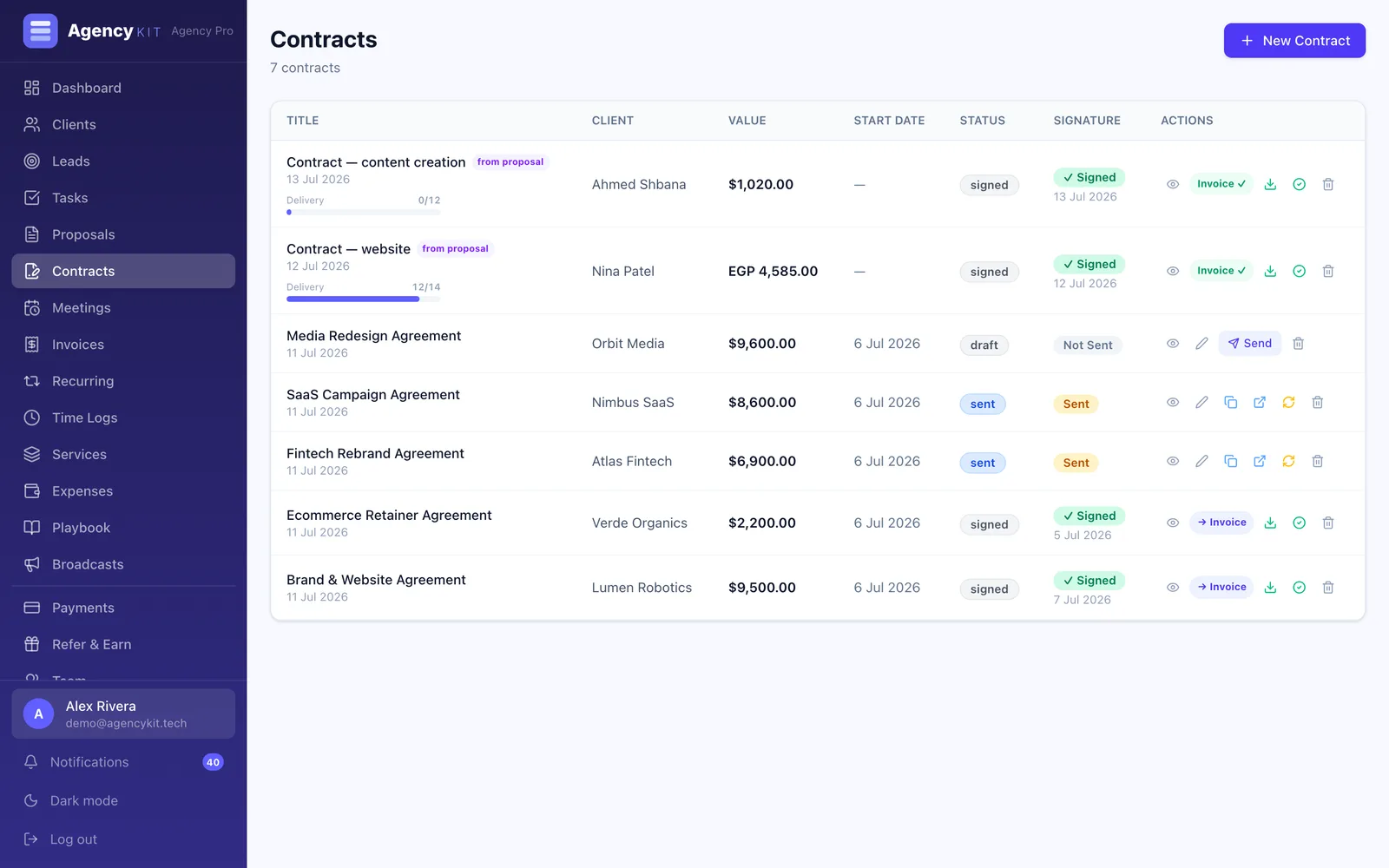
Send the retainer as a proper e-signed contract, not a PDF attachment. AgencyKit lets you send a branded contract for online signature and files the signed copy against the client automatically. The free freelance contract template covers the general clauses.
How to Bill and Manage a Retainer
The admin is where retainers quietly leak money: a monthly invoice that never went out, overage that was never tracked, scope creep that never got billed. A decent setup catches all three:
- Recurring invoices. Bill the fee automatically on the same day each month, in advance, so you never forget and the client always knows what is coming.
- Track against the scope. Log hours or deliverables to the client so you can see how much of the month is used, and spot when someone is heading into overage.
- Bill overage cleanly. When work goes past the scope, add it as a separate line or invoice at the rate you agreed up front.
AgencyKit retainers handle exactly this. Define a monthly package, let completed work draw down against it, invoice the retainer automatically each month, and bill overage on top, with contracts and invoicing living in the same place, from $9/month billed per account.
Wrapping Up
A retainer turns unpredictable project work into steady, recurring income, but only when the scope and terms are clear. Decide whether you are selling access or work, put the scope, fee, and overage rules in writing, bill in advance, and automate the monthly invoice. Get that right and retainers become the most profitable, least stressful part of your business.
Next, tie up the details that keep retainers profitable: your payment terms and the system that gets clients to pay on time.
A retainer agreement sample, clause by clause
A template shows you the shape. A sample shows you the words, and the words are where these documents fail. What each clause actually looks like when it is written to be enforceable rather than to sound reassuring:
The scope clause. Weak: "The Agency will provide ongoing marketing support." Strong: "The Agency will deliver up to 20 hours of work per calendar month across the services listed in Schedule A. Unused hours do not carry forward."
The overage clause. The overage clause is the one most retainer samples leave out, and the one that decides whether the agreement holds in month six. "Work requested beyond the included hours will be quoted in writing before it begins and invoiced at $X per hour."
The payment clause. Name a date, not a rhythm: "The monthly fee of $X is invoiced on the 1st and due within 14 days. Work may be paused on any account more than 15 days overdue."
The notice clause. Symmetry matters more than length. "Either party may terminate with 30 days written notice. Fees for the notice period remain payable."
Two more worth having in writing even though they feel unnecessary while everyone is getting along: who owns the work before the invoice is paid, and who keeps the account logins when the relationship ends.
Key Takeaways
- A retainer agreement is a recurring, usually monthly contract where a client pays to reserve your services or a fixed monthly scope of work
- There are two types, pay-for-access (on call) and pay-for-work (hours or deliverables), and naming which one you are selling prevents most disputes
- Bill the retainer in advance. You are paid before the work, which is the opposite of chasing an invoice afterwards
- A solid agreement is specific about scope, fee, term, unused time, overage, and ownership. Vague scope is the main cause of conflict
- AgencyKit automates recurring retainer invoices, draws completed work down against the monthly scope, and bills overage, from $9/month
Frequently Asked Questions
A retainer fee is a set amount a client pays on a recurring basis, usually monthly and in advance, to reserve your services or a fixed amount of work. A retainer fee is not a deposit against a single project. A retainer fee is ongoing payment for continued access or a monthly scope of deliverables.
You and the client agree a monthly scope and fee, sign a retainer agreement, and the client is invoiced in advance each month. You deliver the agreed work through the month, bill anything beyond the scope as overage, and the retainer renews on its own until either party cancels with notice, commonly 30 days.
A deposit is a one-time, up-front payment against a specific project, taken off the final invoice. A retainer is a recurring monthly fee for ongoing access or a monthly scope of work. A deposit ends when the project does. A retainer keeps going month to month until it is cancelled.
Base it on the monthly scope, not a discount off your project rate. A common approach is to price the hours or deliverables you will reserve each month at your normal rate, then offer a small discount (often 10% to 15%) in return for the commitment and your guaranteed income. Always define overage so extra work still gets paid for.
Refundability depends on the agreement, but retainers are usually non-refundable once the month has started, since the client has reserved your capacity for that period. Spell out your refund and cancellation policy, for example that the final month’s retainer is non-refundable and cancellation needs 30 days’ notice.
At a minimum: the scope of services each month, the fee and billing date, the term and cancellation notice, how unused time is handled, the overage rate for extra work, payment terms and any late fee, and when ownership of the work passes to the client. Keep it specific. Vague scope is the main cause of retainer disputes.
Invoice the fee in advance on the same day each month with a recurring invoice, so it is automatic and predictable. Track hours or deliverables against the scope, and bill any overage as a separate line or invoice at the rate you agreed up front. AgencyKit automates the recurring retainer invoice and the overage billing in one place.
The client pays a fixed amount on a fixed date and receives a defined amount of work in return, and the whole thing turns on how that amount is defined. A retainer agreement example that works names a number: hours, deliverables or units, whether unused ones roll over, and the price of anything beyond it. One that does not name a number becomes an argument in month four. Note that a legal retainer is a different arrangement despite the shared word: a lawyer's retainer is usually money held on account and drawn down against hours, not a fee for a fixed scope.
Reading this in Google? You can tell it to show AgencyKit to you more often.
Sources & References
- Investopedia, "Retainer" and retainer fee definitions. investopedia.com
- U.S. Small Business Administration, contracts and client agreements guidance. sba.gov
- AgencyKit retainers & recurring billing (2026). agencykit.tech/features/retainers