In This Guide
What a care plan actually is
A website care plan, also sold as a website maintenance plan, is a monthly fee for keeping a site alive: updates applied, backups running, security watched, small things fixed, and somebody who answers when it breaks.
For the client it turns an unpredictable risk into a line item. For the agency it turns project work, which stops, into recurring revenue, which does not. That second part is why agencies that sell care plans survive quiet quarters and agencies that only sell builds do not.
Care plan or maintenance plan
Same product, different label. Website care plans and website maintenance plans describe the identical service, and clients search for both about equally. Care plan tends to sell better because it describes a relationship rather than a chore, so use whichever word your market already uses.
What to include, tier by tier
Three tiers is the standard shape, and the reason is not psychology. The reason is that the middle tier is where most clients land, and having a tier priced above it is what makes the middle look reasonable.
| Tier | What it covers | Typical |
|---|---|---|
| Essential | Core, plugin and theme updates. Daily or weekly offsite backups. Uptime monitoring. Security scanning. A monthly report. Email support. | $79 to $199 |
| Growth | Everything in Essential, plus a capped pool of content edits (one to two hours), broken link checks, form testing, and a faster response commitment. | $250 to $500 |
| Priority | Everything in Growth, plus performance work, staging for larger changes, analytics commentary rather than a raw report, and priority response. | $750 and up |
Two things belong in every tier regardless of price. A named response time, because the fear you are selling against is nobody answering. And a monthly report, because a client who cannot see the work will eventually decide it is not happening.
What to charge
Published website maintenance plans cluster tightly around those three price bands, and the bands are what the market bears, but they are not how you should arrive at your number. Work it out from three things.
Your actual cost. Time the work for one month on one real site. Most Essential tiers take between thirty and ninety minutes a month once the routine is set up. Multiply by your internal cost, not your billing rate.
What it protects. A site that generates leads for a business is not being maintained, it is being insured. A plan that costs less than one lost week is easy to justify.
The number of sites. Care plans are a volume business. Twenty sites at $150 is $3,000 a month for work that shares the same tooling and the same hour of your Tuesday. One site at $3,000 is a different and much more fragile business.
The mistake that kills the margin
Almost every unprofitable care plan failed the same way: it did not say what it excluded.
The plan says "small content updates" and month one is a paragraph change. By month four it is a new landing page, and the client is not being unreasonable, they are reading the words you wrote. Nobody agreed where small ends because nobody wrote it down.
Two lines prevent it. Cap the included work in hours, and say plainly what happens when it runs out: quoted separately, or billed at your hourly rate. Clients do not object to a cap. They object to being surprised.
The sentence worth stealing
"Includes up to 2 hours of content changes a month. Unused hours do not roll over. Anything beyond that is quoted before we start."
If the site is WordPress
Most care plans are WordPress care plans, and it changes what you promise rather than what you charge.
Updates are more frequent and occasionally break things, so a staging step and a tested restore matter more than they would elsewhere. A backup nobody has restored is not a backup, and finding that out during an outage is the worst possible time.
Say which plugins you cover and which you do not. A page builder or a commerce plugin can be a business in itself, and a plan that quietly includes unlimited support for one will lose money on it.
Billing it every month
The operational problem with care plans is not the work. The problem is that twenty clients means twenty invoices on the first, forever, and the month somebody forgets is the month cash flow slips.
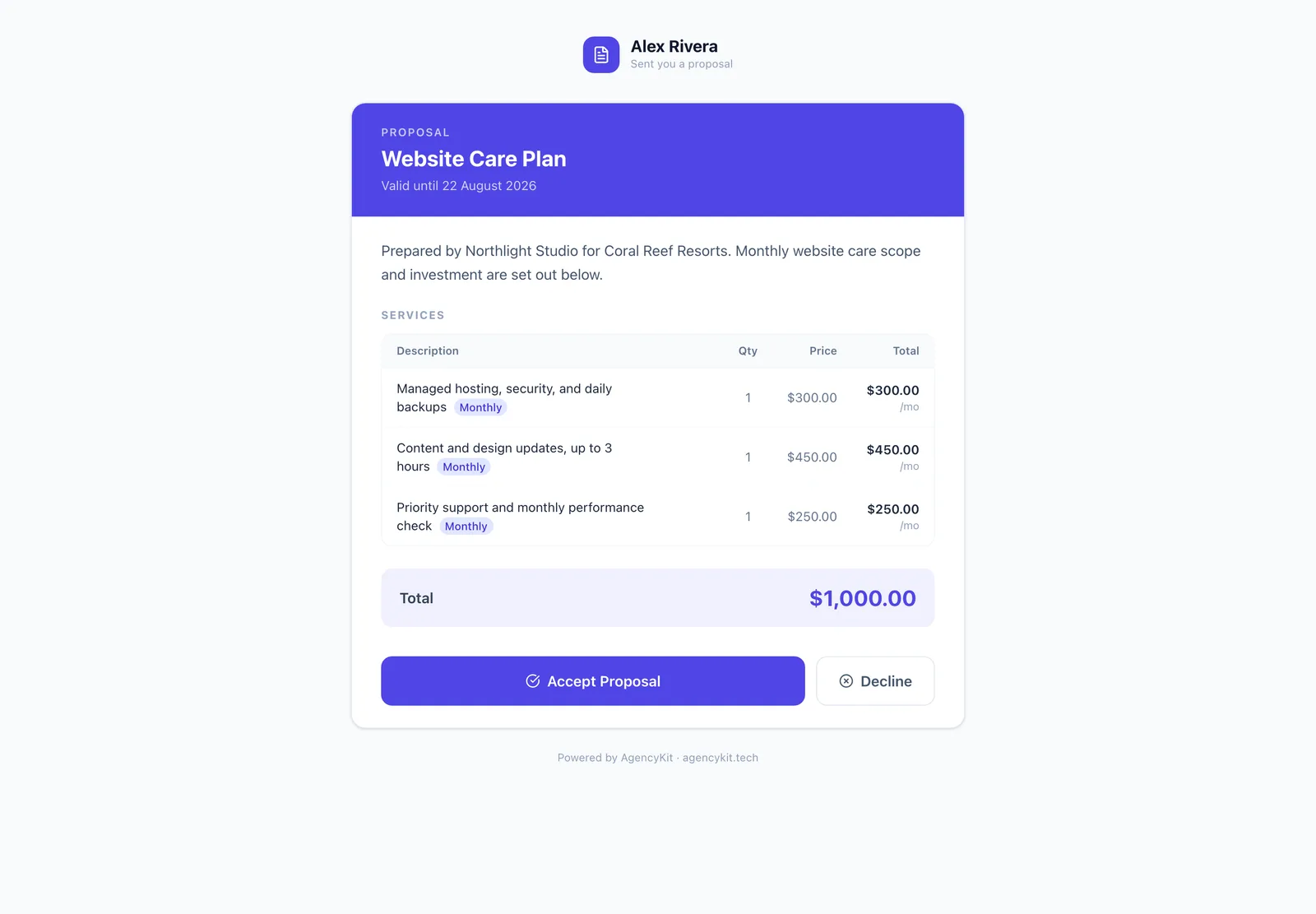
In AgencyKit a care plan is set up once as a monthly package: the fee, the services it covers, and how much of each is included. The work delivered against it consumes those units, the invoice is raised on schedule without anyone remembering, and overdue invoices chase themselves.
Because usage is tracked against the package, the answer to what am I paying for is a list rather than an argument, and a client who is quietly consuming twice what they pay for becomes visible before renewal rather than after.
Invoices are paid by card through the client portal in USD, EUR, GBP, EGP, SAR or AED, so a plan sold across borders does not need a workaround.
When a client says yes, the agreement itself is the next step, and there is a free one here: the website care plan and retainer agreement template covers the clauses, response times and capped hours to put in writing.
Key Takeaways
- A care plan turns project work that stops into recurring revenue that does not
- Three tiers works because the top one is what makes the middle look reasonable
- Common bands are $79 to $199, $250 to $500, and $750 upwards
- Price from your measured cost and the number of sites, not from a competitor page
- The margin dies when the plan does not say what it excludes, so cap the included hours
- On WordPress, a staging step and a tested restore matter more than the price does
Frequently Asked Questions
A website care plan is a fixed monthly fee for keeping a website updated, backed up, monitored and working, usually with a named response time and a monthly report. Agencies sell them because they turn one-off project work into recurring revenue, and clients buy them because an unpredictable risk becomes a predictable line item.
Typical bands in 2026 are $79 to $199 for updates, backups, monitoring and a report, $250 to $500 when a capped pool of content changes is included, and $750 upwards with performance work and priority response. Arrive at your own number by timing the work on one real site for a month rather than copying a competitor page.
Core, plugin and theme updates, offsite backups, uptime monitoring, security scanning, a monthly report and a named response time. Higher tiers add a capped pool of content edits, performance work and staging. What matters as much as the list is stating what is NOT included, because that is where the margin usually goes.
Nothing in substance. Care plans and maintenance plans describe the same recurring service, and both terms are searched about equally. Care plan tends to sell slightly better because it frames the relationship rather than the chore, but the deliverables, the tiers and the pricing are identical either way. Use whichever word your clients use.
Cap the work it includes and write down what happens when the cap is reached. Unprofitable plans almost always failed because "small updates" was never defined, so month four brought a request nobody would call small. A line stating the included hours, that they do not roll over, and that anything beyond is quoted first, prevents most of it.
With recurring invoicing, ideally tied to the work delivered. Raising twenty near-identical invoices by hand on the first of the month works until the month somebody forgets. In AgencyKit the plan is a monthly package: the invoice is raised on schedule, consumption is tracked against it, and overdue invoices chase themselves.
The price is usually the same but the promises differ. WordPress updates arrive more often and occasionally break something, so a staging step and a restore you have actually tested matter more than they would elsewhere. Be explicit about which plugins you cover, since a page builder or a commerce plugin can consume a plan on its own.
Reading this in Google? You can tell it to show AgencyKit to you more often.
References
- AgencyKit retainers and monthly packages (2026). agencykit.tech
- AgencyKit invoicing and recurring billing (2026). agencykit.tech
- AgencyKit pricing, billed per account (2026). agencykit.tech