In This Guide
What it is, and what a CRM is not
Most tools sold to agencies started life as something else. Sales CRMs added an invoice tab. Project tools added a contact list. Accounting software added a client screen. Each is excellent at the thing it was built for and thin everywhere else.
The problem that is specific to an agency is that a client is not an event, it is a relationship that runs for years. The proposal you sent in March becomes the contract you signed in April, the retainer you deliver every month, and the invoice that is nine days late in November. If those live in four tools, nobody can answer a simple question like whether this client is actually profitable.
One question that sorts the category
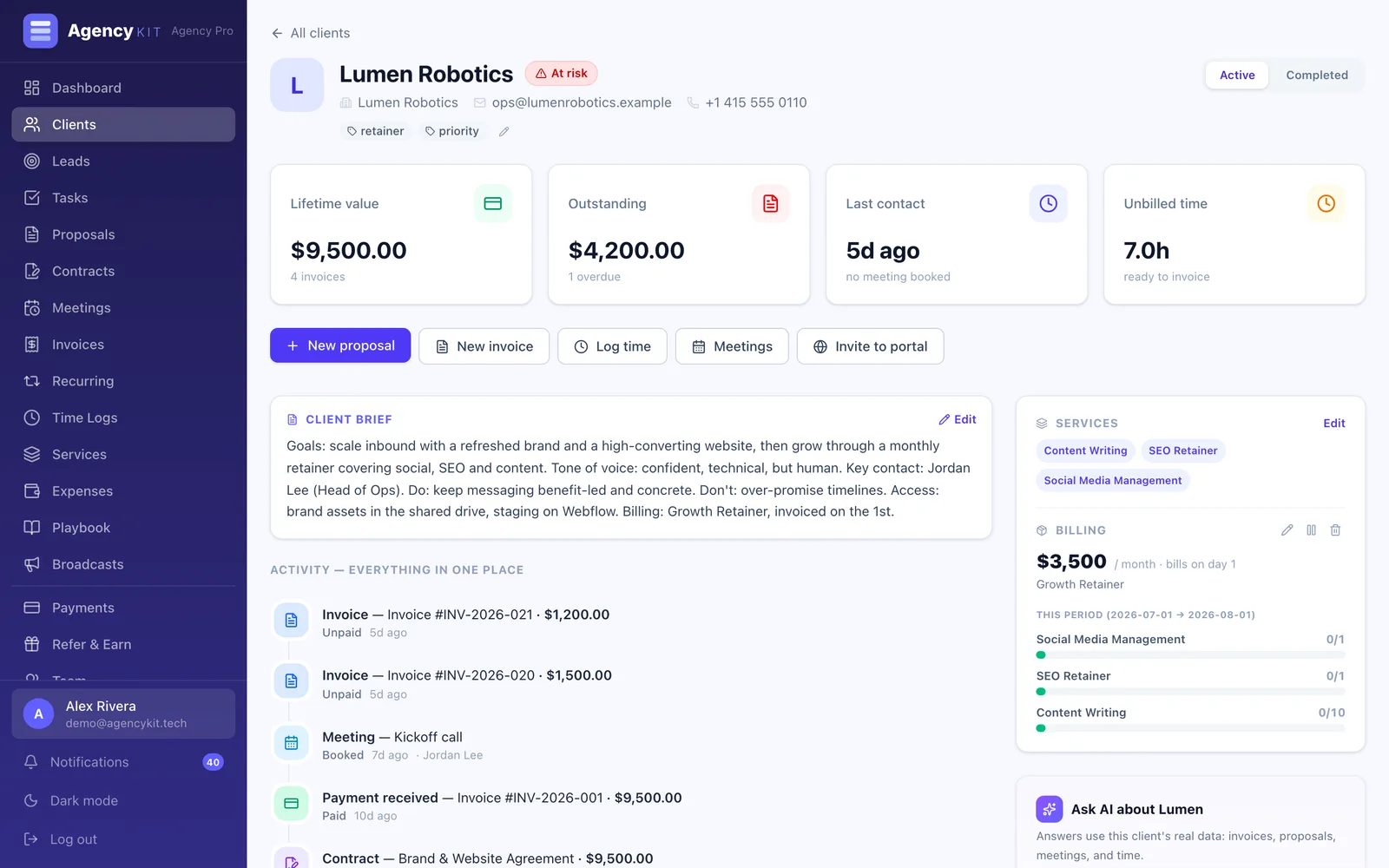
Open a client record and ask: can I see what we agreed, what we delivered, what we billed, and what we were paid, without leaving this screen? If not, the tool is a contact list.
Five signs you have outgrown spreadsheets
Nobody replaces a working spreadsheet for fun. Five moments usually force the switch.
- Somebody asks which invoices are overdue and the honest answer takes twenty minutes.
- A retainer month passes without the work being delivered, and nobody notices until the client does.
- Two people give the same client two different answers about scope.
- You cannot say which of your clients makes money without opening the accounting file.
- Onboarding a new team member means explaining where nine things live.
What a real one includes
Judge a tool on whether it carries the client all the way, not on the length of its feature list.
| Stage | What has to be there | Common gap |
|---|---|---|
| Before the yes | Leads, proposals, follow up | None, everyone has this |
| The yes | Contract with e-signature, linked to the proposal | Signing is a separate tool |
| Delivery | Tasks, time, retainer usage, client approvals | No link to what was agreed |
| Getting paid | Invoices, online payment, overdue chasing | Manual, or a second product |
| Knowing | Profit per client, hours against fee | Almost always missing |
The last row is where most tools stop, and it is the row that changes decisions. Knowing which client is quietly unprofitable is worth more than any feature above it.
What it costs
Expect between $9 and $99 a month for a small agency. The number that matters is not the headline price but whether it is charged per person. A tool at $15 per user is $150 a month for a team of ten, and it gets worse every time you hire.
Per-account pricing inverts that: one fee, everybody included. For a growing team it usually costs less within the first two hires.
How AgencyKit fits
AgencyKit was built for the whole line rather than one stage of it. A lead becomes a proposal, an accepted proposal drafts the contract, a signed contract drafts the invoice and the delivery tasks, and time logged against those tasks shows up in profit per client.
Each client record holds their brief, their contracts, their invoices, their retainer usage, the team assigned to them, and a branded portal they can log into. Reports answer which clients pay late, which are over-serviced, and where the month actually went.
AgencyKit is $9 a month for Starter, $39 for Agency and $69 for Agency Pro, billed per account and not per user, in six currencies.
Key Takeaways
- A CRM covers the weeks before the yes, agency software has to cover the years after
- The test is whether one client screen shows what you agreed, delivered, billed and collected
- Profit per client is the feature most tools skip and the one that changes decisions
- Per-user pricing gets more expensive every time you hire, per-account does not
- Expect $9 to $99 a month for a small agency
Frequently Asked Questions
Agency client management software is one workspace holding everything about a client through the whole relationship: contact details, the proposal you sent, the contract they signed, the work you are delivering, the invoices you raised, and what they have paid. The point is that these are linked rather than living in separate tools, so any question about a client can be answered from one screen.
A CRM is designed for the period before someone becomes a client. A CRM tracks deals, stages and follow-ups, and usually loses interest once the deal is won. Agency client management software has to be useful for the years after that, which means contracts, retainers, delivery and billing belong in the same record as the contact.
A two-person agency can run on spreadsheets for a while. A spreadsheet usually stops working at the point where more than one person needs the same answer, or where retainer months start slipping unnoticed. If somebody has to ask another person to find out what a client is owed, the spreadsheet has already cost more than the software.
Small agency tools generally run between $9 and $99 a month. The more important question is whether the price is per user, because that number is multiplied by your headcount and grows every time you hire. AgencyKit charges per account, so the team size does not change the bill.
That is the main reason to adopt one. Running a proposal tool, an e-signature tool, an invoicing tool and a time tracker separately means four subscriptions and four places where information about the same client disagrees. An all-in-one keeps them linked, so an accepted proposal can draft the contract and a signed contract can draft the invoice.
Some of the best known tools in this category are still limited to a few countries for payments. Check this early if you invoice internationally. AgencyKit works worldwide and supports USD, EUR, GBP, EGP, SAR and AED, so you can quote and invoice in the client currency.
Reading this in Google? You can tell it to show AgencyKit to you more often.
References
- AgencyKit client portal, contracts and invoicing (2026). agencykit.tech
- AgencyKit pricing, billed per account (2026). agencykit.tech
- AgencyKit client CRM (2026). agencykit.tech