What Is a Client Brief?
A client brief is a short document that captures everything an agency needs to start a project well: the client’s goal, audience, scope, timeline, budget, and how success will be judged. A client brief turns a vague request into a clear, shared understanding before any work begins, which is the single cheapest way to prevent misunderstandings and rework later.
Some agencies call it a project brief or a creative brief. Whatever the name, its job is the same: get the important decisions written down and agreed while they are still cheap to change.
What a Good Client Brief Includes
A brief should be short enough that people actually read it, and complete enough that no one has to guess. These eight sections cover it:
- Background and goal, the one business result the project must deliver.
- Audience, who it is for and what they should do.
- Scope and deliverables, exactly what will be produced, and what will not.
- Requirements and constraints, brand, tone, and any must-haves or must-avoids.
- Timeline, milestones and the deadline.
- Budget, the number or range and how it is billed.
- Success criteria, how both sides will judge the result.
- Approvals and contacts, who signs off and who to talk to.
The Client Brief Template
Copy this, fill in the brackets, and share it with the client to confirm before you start.
[Project name] for [Client name / company]. Prepared [date].
What is the client trying to achieve, and why now? [The one business result this project must deliver.]
Who is this for? [Primary audience, their problem, what they should think, feel, or do.]
[List exactly what will be produced, for example: 6-page website, 12 social posts, brand guidelines. Note what is explicitly out of scope.]
[Brand guidelines, tone, must-haves, must-avoids, technical or legal constraints, existing assets.]
[Key milestones and the final deadline. Note any fixed dates.]
[Budget or range, and how it is billed: fixed, hourly, or retainer.]
[How both sides will judge the work a success. Be specific and measurable where possible.]
[Who approves the work, who is the day-to-day contact, and how you will communicate.]
A brief is not a proposal or a scope of work
The brief captures what the client wants and why. The proposal is your answer, framing the work and the price. The scope of work is the detailed, agreed list of deliverables once they say yes. A good brief feeds straight into the proposal and the scope, so nothing gets re-typed or lost.
How to Use the Brief
The same brief, without the document. In AgencyKit the brief lives on the client rather than in a file, and the client fills it in themselves from a link. Its sections are not a fixed list: they come from the services that client actually buys, so a design retainer asks design questions and an SEO retainer asks SEO ones, across five crafts (design, content, media, SEO and development). A completeness meter shows how much of it is answered, so chasing the missing half is one glance rather than a re-read. It is on every plan, starting at $9 a month.
Send the brief to the client and get their sign-off in writing before you scope or price the work. That agreement is what protects you when someone later remembers the goal differently. From there, the brief becomes the backbone of your proposal, and its scope section becomes your scope of work, which is your best defence against scope creep.
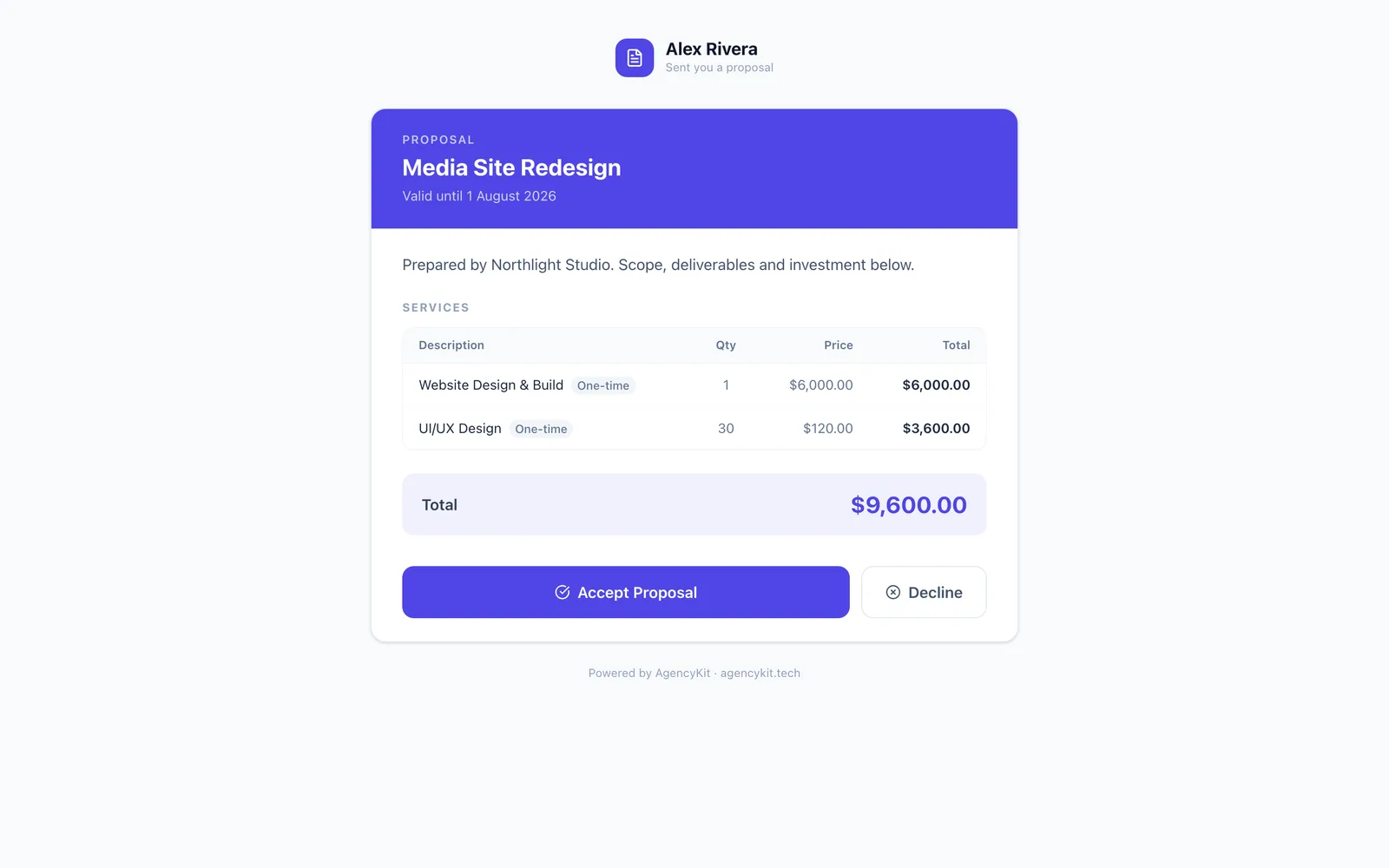
In AgencyKit, you can turn an agreed brief into a branded proposal the client accepts online, then into a contract and an invoice, without re-entering the client, the scope, or the price.
Related Guides
See the free proposal and scope of work generator, the client welcome packet template, and the proposals and scope guide.
Marketing brief, product brief and creative brief
The word brief covers several documents that share a purpose and differ in what they capture. Using the wrong one produces a document that is either too vague to act on or too long for anyone to read.
A client brief, the one on this page, captures the client: their business, audience, brand, competitors, access and approval chain. A client brief is written once and stays useful across everything you do for them.
A marketing brief narrows to a campaign. A marketing brief adds the objective in a number, the audience for this specific push, the message, the channels, the budget and the dates. A marketing brief assumes the client brief already exists and does not repeat it.
A product brief describes a thing rather than a campaign: what it does, who it is for, what problem it removes, how it is priced, what makes it different, and what the constraints are. Agencies usually receive one rather than write it.
A creative brief is the shortest and the hardest. A creative brief exists to point a designer or writer at a single idea: the one thought, the tone, the mandatories, the deliverable list and the deadline. A creative brief longer than a page has usually become a marketing brief with a different title.
The practical rule is to keep the client brief standing and write a short brief per piece of work rather than restating the background every time. A team that rewrites the client context on every job eventually stops reading any of it.
Key Takeaways
- A client brief captures the goal, audience, scope, timeline, budget, and success criteria before work begins
- A client brief is the cheapest way to prevent misunderstandings and rework later
- Get the brief agreed in writing, then feed it into your proposal and scope of work
- A brief is not a proposal or a scope of work; it is the input that shapes both
- AgencyKit turns an agreed brief into a proposal, contract, and invoice without re-typing
Frequently Asked Questions
A client brief is a short document that captures everything an agency needs to start a project: the client’s goal, audience, scope, timeline, budget, and how success will be judged. A client brief turns a vague request into a clear, shared understanding before any work begins.
A good client brief covers the background and goal, the audience, the scope and deliverables, requirements and constraints, the timeline, the budget, the success criteria, and who approves the work. Keep it short enough to read and complete enough that no one has to guess.
A brief captures what the client wants and why. A proposal is your answer to it: how you will help, the scope, and the price. The brief usually comes first and feeds the proposal, so the two stay consistent.
Either side can start it. Often the agency drafts it from a discovery call and the client confirms and corrects it, which surfaces any misunderstanding early. The important thing is that both sides agree the brief in writing before work begins.
They overlap. A creative brief focuses on the message, audience, and tone for creative work. A client brief is broader and covers scope, timeline, and budget too. This template works for both, so you can trim the sections you do not need.
Mostly, and the difference is scope rather than substance. A client brief captures the client: their business, audience, brand, access and approval chain, and it stays useful across everything you do for them. A project brief narrows to one piece of work, adding objectives, deliverables, timeline and budget for that project alone. If you work with a client more than once, keep the client brief as the standing document and write a short project brief per engagement instead of repeating the background every time.
Yes. In AgencyKit the brief belongs to the client record and the client fills it in from a link, so there is no file going back and forth and no version to reconcile. The sections come from the services that client buys rather than from a fixed list, covering design, content, media, SEO and development, and a completeness meter shows how much is still unanswered. It is on every plan from $9 a month.
Reading this in Google? You can tell it to show AgencyKit to you more often.
Sources & References
- AgencyKit proposals and client management (2026). agencykit.tech