What Copywriters Need From Client Management Software
Copywriting is a business of many small relationships. You might be drafting a landing page for one client, a set of emails for another, and a brand voice guide for a third, each with its own brief, deadline, and round of edits. The writing is the easy part. The admin around it, chasing sign-off, sending invoices, keeping revisions from spiralling, is what quietly eats your week.
Good client management software takes that weight off. For a copywriter, the parts that matter most are:
- Proposals that spell out the deliverable, the word count or scope, and how many revisions are included.
- Contracts that set usage rights, a revision limit, and payment terms, so a project cannot quietly grow forever.
- Deposits and invoicing so you get paid up front and on time without awkward reminders.
- Retainers for the ongoing content clients who need words every month.
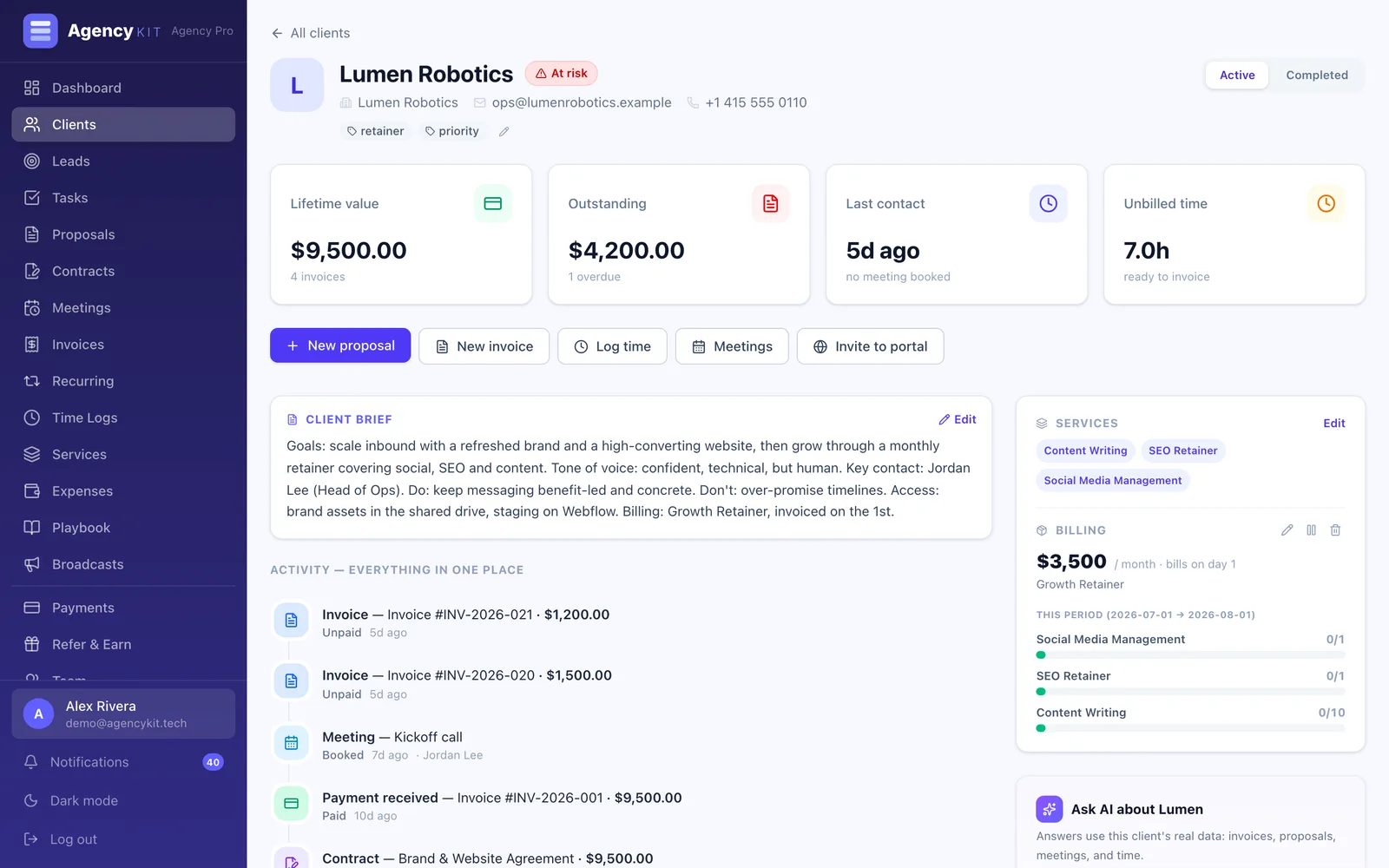
- One place per client that holds the brief, the history, and the billing, so you are never digging through email to find a detail.
A Copywriter’s Client Workflow, From Pitch to Paid
Most copywriting projects follow the same shape. Having software that mirrors it means you run the same clean process every time instead of improvising.
- Send a proposal. Lay out the deliverable, the scope in plain numbers (word count, number of pieces), and how many revision rounds are included.
- Sign a contract. Capture usage rights, the revision limit, a kill fee if the client walks away mid-project, and clear payment terms.
- Take a deposit. A deposit of 25 to 50 percent before you write filters out the clients who were never serious.
- Write and manage revisions. Keep edits inside the agreed rounds. Anything beyond that is a paid extra, not a favour.
- Deliver and invoice the balance. Send the final piece and the closing invoice together, so payment is the natural next step.
- Set up a retainer. For clients who need content regularly, a monthly retainer turns one project into predictable income.
Put your revision limit in writing
The number one cause of unpaid copywriting hours is the endless tweak. A proposal and contract that state, for example, two rounds of revisions included, further rounds billed hourly, give you a calm, professional way to say no more free edits without any awkward conversation. See our free contract template for the wording.
The Features That Matter Most for Copywriters
Not every feature earns its place in a writer’s toolkit. These are the ones that pull their weight.
Scope-tight proposals. A proposal that names the deliverable and the revision count is your first line of defence against scope creep. When the boundaries are agreed in writing before you start, the whole project stays calmer.
Contracts built for creative work. A copywriting contract should cover who owns the words and when (usage rights usually transfer on final payment), how many revisions are included, and a kill fee if the client cancels partway. Our free freelance contract template is a solid starting point.
Deposits and painless invoicing. Taking a deposit up front and sending clean, on-time invoices is the difference between a healthy freelance income and constant chasing. Getting paid should be one click for the client.
Retainers for ongoing content. Blog posts, newsletters, and social copy are rarely one-and-done. A retainer agreement sets a monthly scope and a monthly payment, which smooths out the feast-and-famine cycle every freelancer knows.
A single home for each client. One record per client, holding the brief, the tone-of-voice notes, the billing, and the full history, means you never start a session by hunting for context.
One Tool, or a Stack of Separate Apps?
Plenty of copywriters run their business on a patchwork: a document for proposals, a separate app for signatures, another for invoices, and a spreadsheet to remember who owes what. It works, but it is fiddly, and it costs more than it looks once you add up the subscriptions. For a solo writer, an all-in-one is usually cheaper and calmer, because the proposal, contract, invoice, and client notes share one login and one source of truth. Fewer tools, fewer things to forget.
AgencyKit for Copywriters
AgencyKit runs this whole flow for you. An accepted proposal becomes a contract and a deposit invoice, each client gets a single record with their brief and history, and ongoing clients sit on retainers that bill automatically each month. It is built for solo freelancers and small teams alike, priced as one flat fee per account from $9 a month, with a 14-day free trial and no card required. If you also work in a nearby field, we have guides on client management software for consultants and web designers, plus a deeper look at proposal software for freelancers.
Wrapping Up
The right client management software lets a copywriter spend more time writing and less time on admin. Send scope-tight proposals, sign contracts that set revision limits and usage rights, take deposits, invoice on time, and put ongoing clients on retainers, all from one place per client. Whether you use an all-in-one or a careful stack of tools, the goal is the same: a repeatable, professional process that protects your time and gets you paid. For a solo writer juggling several clients, having it in one tool is usually the simplest way there.
Start with the paperwork that protects you: grab the free contract template and the free proposal template.
Key Takeaways
- Copywriters juggle many small client relationships, and the admin around the writing is what eats the week, so one repeatable process helps most
- The features that matter: scope-tight proposals, contracts with revision limits and usage rights, deposits, easy invoicing, and retainers for ongoing content
- Put your revision limit in writing in both the proposal and the contract to stop endless free edits
- For a solo writer, an all-in-one is usually cheaper and calmer than a stack of separate apps for documents, signatures, and invoices
- AgencyKit runs proposal to contract to deposit to invoice to retainer, with one record per client, from $9/month billed per account and a 14-day free trial
Frequently Asked Questions
The best tool covers your whole workflow in one place: proposals that fix the scope, contracts with revision limits and usage rights, deposits, invoicing, and retainers for ongoing content. AgencyKit does all of that from $9 a month billed per account, with a client record that holds each project’s brief and history, so a solo copywriter can run several clients without juggling separate apps.
Many use a patchwork: a document tool for proposals, an e-signature app for contracts, an invoicing tool, and a spreadsheet to track who owes what. It works, but it is fiddly and costs more once you add up the subscriptions. An all-in-one like AgencyKit replaces that stack with one login where the proposal, contract, invoice, and client notes all live together.
With clear limits set in writing before the work starts. A copywriting contract should state how many revision rounds are included and that further rounds are billed as extras, so edits cannot spiral into unpaid hours. It should also cover usage rights and payment terms. Naming the revision count in both the proposal and the contract gives you a calm, professional way to hold the line.
Yes. A deposit of 25 to 50 percent before you begin protects your time and filters out clients who were never fully committed. It also improves your cash flow, since you are not carrying the whole project on trust. Taking the deposit as part of an accepted proposal or a first invoice makes it a normal, expected step rather than an awkward request.
Give every client a single home that holds their brief, tone-of-voice notes, deadlines, billing, and history, so you never lose context switching between them. Use templates for your proposals, contracts, and invoices so each new client is quick to set up. When the whole process is repeatable and each client’s details sit in one record, juggling several at once stops feeling chaotic.
At a minimum: the scope and deliverables, the number of revision rounds included, who owns the copy and when (usage rights, usually transferring on final payment), a kill fee if the client cancels partway, and clear payment terms with a deposit. A free freelance contract template gives you a solid starting structure that you can adapt to each project.
If you have clients who need content regularly, such as blog posts, newsletters, or social copy, retainers are one of the best ways to steady your income. A retainer sets a monthly scope and a monthly payment, which smooths the feast-and-famine cycle of one-off projects. Not every client suits a retainer, but for ongoing content work it turns unpredictable jobs into reliable revenue.
Yes. AgencyKit runs the full pitch-to-paid flow a copywriter needs: proposals that fix the scope, contracts with e-signature, deposits and invoicing, and retainers for ongoing content, all with one record per client. It is priced as a flat fee per account from $9 a month, works internationally, and has a 14-day free trial, so you can run a real client through it before deciding.
Reading this in Google? You can tell it to show AgencyKit to you more often.
Sources & References
- AgencyKit proposals, contracts & retainers (2026). agencykit.tech
- U.S. Small Business Administration, contracts and getting paid guidance. sba.gov
- AgencyKit features & pricing (2026). agencykit.tech/pricing