What Is a Consulting Retainer Agreement?
A consulting retainer is an arrangement where a client pays a set monthly fee for ongoing access to your advice, usually up to a capped number of hours. A retainer turns consulting from a series of one-off projects into steady, predictable income, and it suits advisory work well, because clients often need a trusted expert on hand month after month rather than for a single engagement. Where a scope of work defines the advisory itself, the retainer agreement sets the commercial terms: the fee, the hours, availability, and cancellation.
The retainer is also what protects a consultant from the classic trap of ongoing work: unlimited access for a fixed fee. A clear agreement caps the time and sets the expectations, so a monthly relationship stays sustainable.
The Free Consultant Retainer Template
A complete consulting retainer agreement to copy and adapt: The template handles the terms that matter in advisory work: capped hours, response times, unused-hour rules, and confidentiality. Replace everything in [brackets].
2. Monthly retainer fee. [$X,XXX] per month, for the advisory scope set out in the attached scope of work.
3. What is included. Up to [X] hours per month of advisory: [strategy sessions, async advice on business days, and a monthly review]. Detail is in the scope of work.
4. Availability and response time. Available on [business days]. Async requests answered within [2] business days. Out-of-hours or on-call access is not included.
5. Unused hours. Hours reserved each month do not roll over. The Consultant holds capacity for the Client whether or not every hour is used.
6. Extra work. Work beyond the monthly hours, or implementation and delivery, is quoted separately before it begins.
7. Minimum term and renewal. An initial [3] month term, after which the retainer continues month to month, renewing automatically until cancelled.
8. Confidentiality and materials. Both parties keep shared information confidential. Any materials created specifically for the Client become theirs on payment.
9. Payment. Billed on the [1st] of each month, due [on receipt], in advance. The first month is paid before the engagement begins.
10. Cancellation. After the minimum term, either party may cancel with [30] days written notice. The final month is worked and paid in full.
Signed: [Consultant] __________ [Client] __________ Date: __________
Cap the hours, and hold the line on rollover
The two clauses that keep a consulting retainer profitable are the monthly hour cap and the rule that unused hours do not roll over. You are reserving your time and attention each month, whether the client uses every hour or not. Without these, a quiet month becomes a demand for double the time later, and the retainer stops making sense for you.
The Terms That Keep an Advisory Retainer Fair
Beyond the fee, a few clauses keep a consulting retainer working for both sides.
Capped monthly hours. State the hours included and that the retainer is for advice within them. Capped monthly hours are the core of an advisory retainer, and they must be explicit.
Response time, not on call. Define when you are available and how quickly you respond to async requests. A retainer buys reliable access on business days, not a hotline.
Extra work and implementation. State that anything beyond the hours, or hands-on implementation, is quoted separately. Quoting implementation separately keeps the retainer advisory and stops it sliding into unpaid delivery work.
Confidentiality and materials. Keep confidentiality mutual, and state that materials created specifically for the client become theirs on payment, so ownership is never in doubt.
Bill the Retainer in Advance, Track the Hours
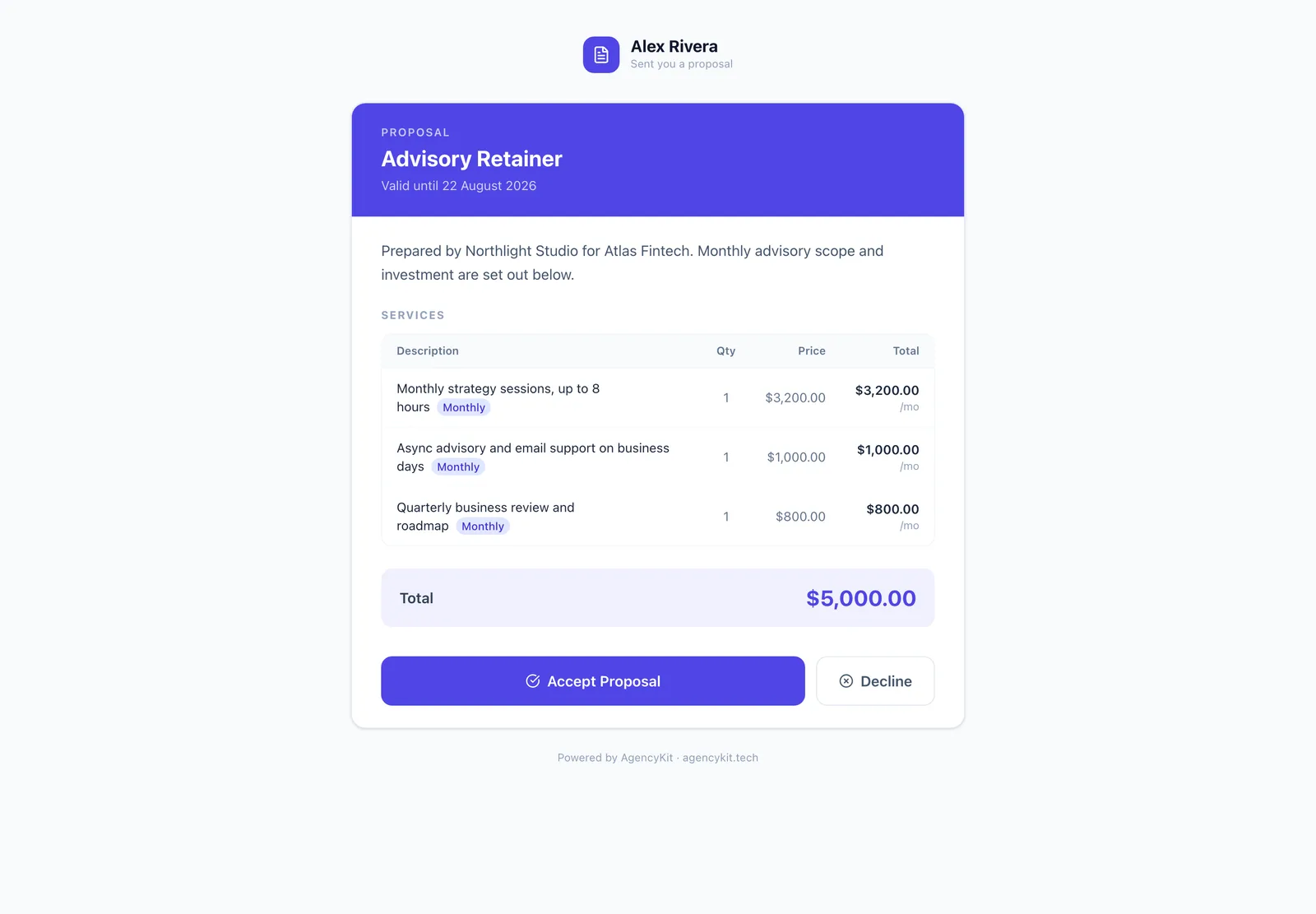
A consulting retainer should pay you predictably and stay within its hours. In AgencyKit, the agreed retainer invoices automatically at the start of each month, and built-in time tracking lets you see how the hours are being used against the cap. Each client keeps one record with their agreement, sessions, and history. See client management software for consultants.
Wrapping Up
A consulting retainer agreement turns advisory work into a stable business. Set the monthly fee and the capped hours, define your availability and response time, keep unused hours from rolling over, and put implementation and extra work out of scope. Keep confidentiality mutual, then bill in advance and track the hours. Copy the template, set your terms, and turn your best advisory clients into steady monthly income.
Pair it with the consulting scope of work template for the engagement itself, and read what a retainer agreement should include.
Key Takeaways
- A consulting retainer sells ongoing access to your advice up to a capped number of monthly hours
- Cap the hours and set a response window, so a fee never becomes unlimited, on-call access
- Unused hours usually do not roll over, because you reserve your time each month
- Keep implementation and out-of-hours work out of scope, and keep confidentiality mutual
- Bill the retainer in advance and track the hours against the cap so you can spot when a client should move up a tier
Frequently Asked Questions
A consulting retainer agreement sets the commercial terms of ongoing advisory work: a monthly fee for up to a capped number of the consultant’s hours, availability and response expectations, the rules for unused hours, confidentiality, and cancellation. It works alongside a scope of work, which defines the advisory itself, while the retainer agreement governs the money, the hours, and the term.
The client pays a set fee each month, usually in advance, for ongoing access to your advice up to a capped number of hours. You reserve that time and attention monthly and respond within an agreed window on business days. A scope of work defines what the advisory covers, and the retainer agreement sets the fee, hours, availability, and cancellation. A consulting retainer gives the consultant predictable income and the client a reliable expert on hand.
The right cap depends on the client’s needs and your rate, so set it deliberately rather than leaving it open. Advisory retainers commonly include anywhere from a few hours to a few dozen hours a month. The key is to state a specific cap, because an uncapped retainer becomes unlimited access for a fixed fee. Price the retainer on the hours reserved, not on how many the client happens to use.
Usually not, and the agreement should say so. You reserve your time and attention for the client each month whether they use every hour or not, so unused hours typically do not carry over. Stating this prevents a quiet month from becoming a demand for double the time later. If you do allow limited rollover, cap it tightly so your schedule stays predictable.
The scope of work defines the advisory engagement: the objective, the services, the hours, and what is out of scope. The retainer agreement sets the commercial terms around it: the monthly fee, availability, response time, unused-hour rules, confidentiality, and cancellation. Keeping them separate lets you adjust the advisory focus without rewriting the whole agreement, and keeps each document clear.
Cap the hours, define your availability, and state that out-of-hours access is not included. A retainer should buy reliable advice on business days up to a set number of hours, not a hotline. A retainer should also state that work beyond the hours, or hands-on implementation, is quoted separately. Together these clauses keep a monthly fee from quietly turning into round-the-clock, unlimited demand on your time.
It is optional and common. A short minimum term, such as three months, ensures the client commits long enough for the relationship to be worthwhile and for your advice to have an effect. Others run month to month with a notice period. Whichever you choose, include a clear cancellation clause, typically 30 days notice with the final month worked and paid in full, so the exit is orderly.
Bill it in advance at the start of each month and automate it, so you are not invoicing by hand. Use time tracking to see how the included hours are being used against the cap, which makes it easy to flag when a client is running over and needs to move up a tier. In an all-in-one tool the retainer invoices on schedule and the hours are tracked in the same place.
For most consulting work, yes, with one condition: read it rather than filling in the blanks. A sample contract for consulting services covers the standard ground well, meaning parties, services, fees, term, ownership and termination. What it cannot know is the part specific to you, which is usually the scope and the boundary around it. Two clauses are worth adding by hand every time: what happens when the client asks for something outside the agreed scope, and who owns the work if an invoice goes unpaid.
Reading this in Google? You can tell it to show AgencyKit to you more often.
Sources & References
- U.S. Small Business Administration, contracts and getting paid guidance. sba.gov
- AgencyKit retainers, time tracking & invoicing (2026). agencykit.tech
- AgencyKit client management for consultants (2026). agencykit.tech