What Is a Consulting Scope of Work?
A scope of work for a consultant defines the boundaries of an advisory engagement: what you will advise on, how much of your time is included, what outputs the client gets, and, crucially, what you are not responsible for. Consulting is different from delivery work, because what you sell is judgment and time rather than a stack of finished assets. Selling judgment makes the scope more important, not less, because without it "an advisory engagement" can quietly expand into being on call at all hours for problems that were never part of the deal.
A good consulting scope protects the two things consultants most often lose: their time and their accountability. A good consulting scope caps the hours, and draws a clear line between giving advice and owning the outcome.
The Free Consulting Scope of Work Template
Here is a full consulting scope you can copy and adapt. The template is built around the things that matter in advisory work: an objective, capped time, response expectations, and the line between advice and execution. Replace everything in [brackets].
2. Objective. The advisory supports the Client in [the specific goal, for example "improving retention" or "launching in a new market"]. The engagement is defined by this objective, not by open-ended availability.
3. Services and deliverables. For example: [monthly strategy sessions, up to 8 hours]; [a written recommendations document each quarter]; [async advisory by email on business days]. Specify the meetings, hours, and any written outputs.
4. Time and availability. Up to [X] hours per month. The Consultant responds to async requests within [2] business days, on business days. Out-of-hours or on-call access is not included.
5. Out of scope. Hands-on execution and implementation, work outside the stated objective, and any deliverable not listed in section 3. These are quoted separately.
6. Nature of advice. The Consultant provides recommendations and expertise. Decisions, their implementation, and their outcomes remain the Client's responsibility.
7. Confidentiality. Both parties keep shared information confidential. [Governed by a separate NDA, if one applies.]
8. Client responsibilities. Access to the people, data, and context the Consultant needs, and timely decisions so the work can progress.
9. Payment. [A deposit before work begins, or a monthly fee billed in advance for ongoing advisory.]
Signed: [Consultant] __________ [Client] __________ Date: __________
Separate advice from outcomes, in writing
The clause that protects a consultant most is the one that says you provide recommendations, while decisions and their results stay with the client. You cannot guarantee a business result you do not control, and a client who acts on some of your advice and ignores the rest should not be able to hold you responsible for the outcome. Say it plainly and early.
What a Consulting Scope Must Define
A few sections do the real work in an advisory scope.
An objective, not open availability. Anchor the engagement to a specific goal. "Advisory support" with no objective becomes a bottomless request queue. "Advising on the retention strategy" has natural edges.
Capped hours and response times. Consulting is sold by time, so cap it: a set number of hours a month, and a response window for async questions on business days. A capped number of hours is what stops a monthly fee from becoming round-the-clock availability.
Advice versus execution. Be explicit that you advise and the client implements, unless implementation is a listed, separately priced deliverable. Consultants get dragged into doing the work they were hired to guide, and this line prevents it.
Confidentiality. Advisory work means seeing sensitive information. A confidentiality clause, or a reference to a separate NDA, belongs in every consulting scope.
Turn the Scope Into a Signed Engagement
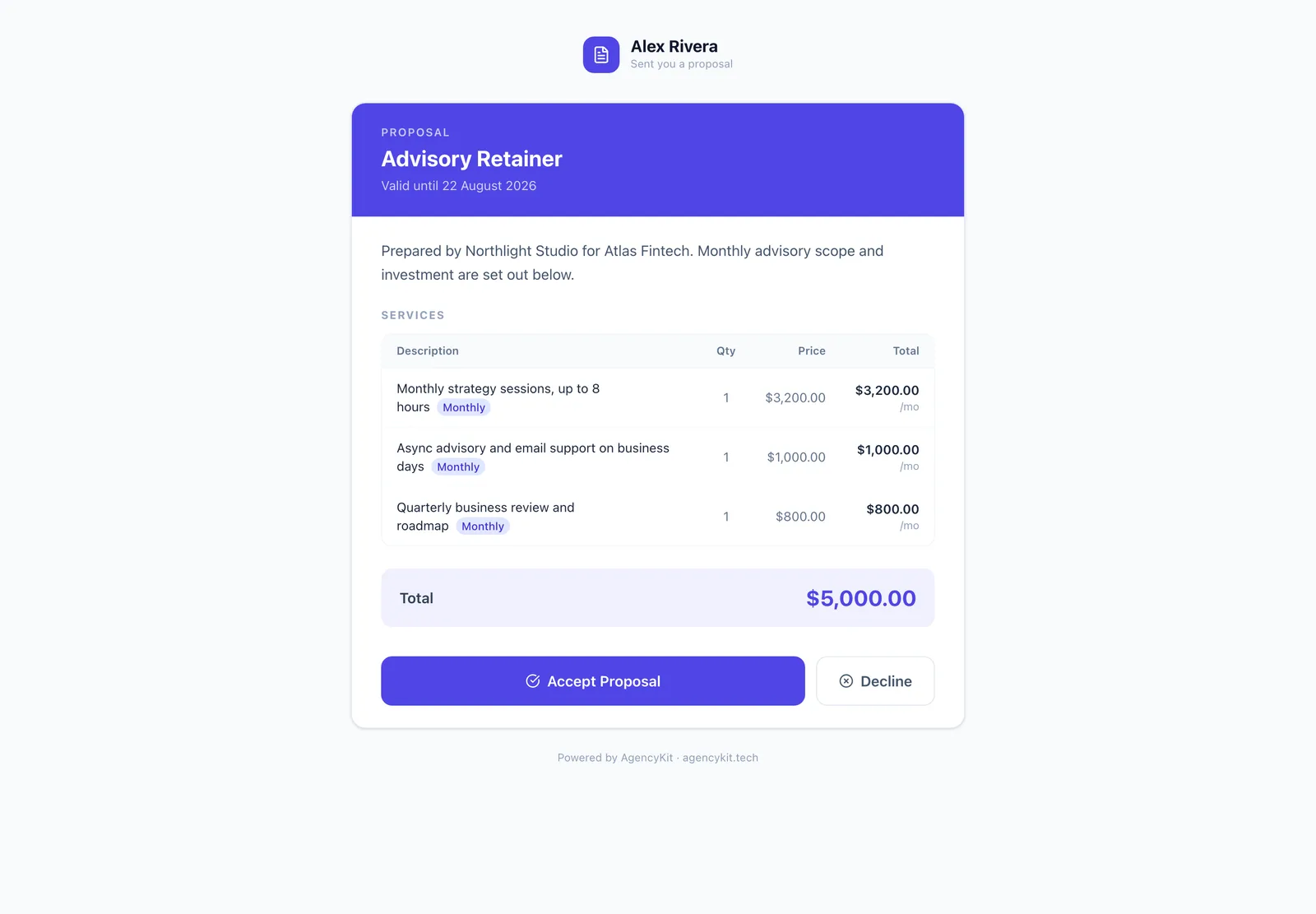
A consulting scope becomes real income when it is agreed and billing. In AgencyKit, you present the scope as a proposal the client accepts online, it flows into a contract, and for ongoing advisory you set it up as a retainer that invoices each month, with time tracking to keep an eye on the hours. See our guides to client management software for consultants and proposal software for consultants.
Wrapping Up
A consulting scope of work protects your time and your accountability at once. Anchor the engagement to a clear objective, cap your hours and set response expectations, separate advice from execution, and keep confidentiality in writing. Then present it as a proposal the client signs. Copy the template, set your terms, and take on advisory work with clear edges instead of an open-ended commitment.
For ongoing clients, add the consultant retainer agreement template, and see how to stop scope creep.
Key Takeaways
- A consulting scope protects your time and your accountability, because consulting sells judgment and time, not finished assets
- Anchor the engagement to a specific objective rather than open-ended "advisory support"
- Cap your monthly hours and set a response window, so a fee never becomes on-call availability
- Separate advice from execution: you recommend, the client decides and implements, unless execution is a paid deliverable
- Keep confidentiality in writing, and present the scope as a proposal the client signs
Frequently Asked Questions
A consulting scope of work is the document that defines the boundaries of an advisory engagement: the objective being worked toward, the services and any written outputs, how many hours of the consultant’s time are included, response expectations, and what is out of scope. Because consulting sells judgment and time rather than finished deliverables, the scope is what keeps an engagement from expanding into open-ended, on-call availability.
Anchor it to a specific objective; list the services and deliverables (sessions, hours, any written recommendations); cap the monthly hours and set a response window for async requests; state that you provide advice while decisions and outcomes stay with the client; put execution and out-of-objective work out of scope; include confidentiality; list the client’s responsibilities; and set the payment terms.
By capping time and anchoring to an objective. State a set number of hours a month and a response window (for example two business days) on business days, and make clear that out-of-hours or on-call access is not included. Tying the engagement to a specific goal rather than open "advisory support" also gives it natural edges, so it does not become a bottomless request queue.
No, and the scope should say so. A consultant provides recommendations and expertise, but decisions, implementation, and outcomes remain the client’s, since you do not control whether or how your advice is acted on. State plainly that you advise and the client decides. Saying plainly that you advise and the client decides protects you from being held responsible for a result that depended on choices and factors outside your hands.
Advice is guiding, recommending, and bringing expertise. Execution is doing the hands-on work of implementing the recommendations. A consulting scope should make clear that you provide the advice while the client (or someone else) implements, unless implementation is a listed, separately priced deliverable. That line prevents the common problem of a consultant being pulled into doing the very work they were hired to guide.
Yes. Advisory work almost always involves seeing sensitive business information, so a confidentiality clause, or a reference to a separate non-disclosure agreement, belongs in every consulting scope or contract. A confidentiality clause protects the client’s information and sets a professional standard. If the engagement is with a larger organization, they will often require their own NDA in addition.
Project and retainer pricing both work, and the scope adapts to either. For a defined piece of advisory work with an end point, a project fee with a deposit fits. For ongoing advice, a monthly retainer billed in advance is cleaner, covering a set number of hours each month. Many consultants use a project to start, then move the client onto a retainer for continuing support once the initial work is done.
Present it as a clear proposal the client can accept online, with the objective, hours, and fee laid out, then convert it into a contract. For ongoing advisory, set it up as a retainer that invoices each month. In an all-in-one tool the accepted proposal flows into a contract and recurring invoice, and time tracking lets you keep the hours within the agreed cap without extra admin.
Yes, with one habit: treat the exclusions as the part you write yourself. A scope of work template for a consultant covers the standard ground well, meaning deliverables, timeline, dependencies and acceptance. What it cannot know is where your particular engagement will drift, and that is almost always the same place, which is the client asking for a small thing outside the scope in week six. Write what is not included and what happens when it is asked for, and the template does its job.
Reading this in Google? You can tell it to show AgencyKit to you more often.
Sources & References
- U.S. Small Business Administration, contracts and scope guidance. sba.gov
- AgencyKit proposals, contracts, time tracking & retainers (2026). agencykit.tech
- AgencyKit client management for consultants (2026). agencykit.tech