What Is a PR Retainer Agreement?
A PR retainer agreement sets the commercial terms of an ongoing public relations engagement: the monthly fee, the activity it covers, how coverage is treated, the minimum term, and cancellation. PR is a relationship business that builds over months, so it runs on a retainer rather than a one-off project. Where a scope of work lists the monthly activity, the retainer agreement governs the money, the term, and the crucial results clause.
The retainer is what protects a PR relationship through the natural ups and downs of the news cycle. A PR retainer commits the client to the timeline PR needs and protects the agency from being judged on a quiet month, while keeping it accountable for consistent, professional work.
The Free PR Retainer Template
A complete PR retainer agreement to copy and adapt: The template handles the terms that matter for media work: the results clause, approvals, a minimum term, and scope changes. Replace everything in [brackets].
2. Monthly retainer fee. [$X,XXX] per month, for the PR activity in the attached scope of work.
3. Services included. [Media relations and outreach, a set number of press releases, media list management, monthly reporting, and messaging support], as detailed in the scope.
4. Results. The Agency commits to consistent, professional outreach and activity. Media coverage is decided by journalists and editors and is not guaranteed.
5. Approvals. All statements, quotes, and releases are approved by the Client before distribution.
6. Minimum term and renewal. An initial [3] month term, because PR builds over time, after which the retainer continues month to month, renewing automatically until cancelled.
7. Unused work. The monthly activity is reserved for the Client and does not roll over.
8. Scope changes. Events, crisis communications beyond the agreed allowance, and new campaigns are quoted and agreed in writing before they begin.
9. Payment. Billed on the [1st] of each month, due in advance. The first month is paid before work begins.
10. Cancellation. After the minimum term, either party may cancel with [30] days written notice. The final month is worked and paid in full.
Signed: [Agency] __________ [Client] __________ Date: __________
The results clause is the heart of a PR retainer
Almost every PR dispute comes down to a mismatch on coverage. Your retainer must state that you commit to activity and professional outreach, and that coverage is decided by the media. A results clause is not a disclaimer to hide behind, it is honesty about how PR works, and it keeps the relationship healthy when a placement takes longer than the client hoped.
The Clauses That Protect a PR Retainer
A few terms keep a PR retainer fair through the news cycle.
The results clause. Commit to activity and outreach, and state that coverage is not guaranteed. This is the single most important line.
Approvals. Keep the client sign-off on statements and releases in the retainer, so nothing goes out unapproved and the client owns their message.
Minimum term. A minimum term gives PR the months it needs to build relationships and momentum, and signals a serious commitment on both sides.
Scope changes. Events, crises, and new campaigns fall outside standard media relations. A clause that quotes them separately keeps the retainer focused and protects your capacity.
Bill the Retainer Automatically
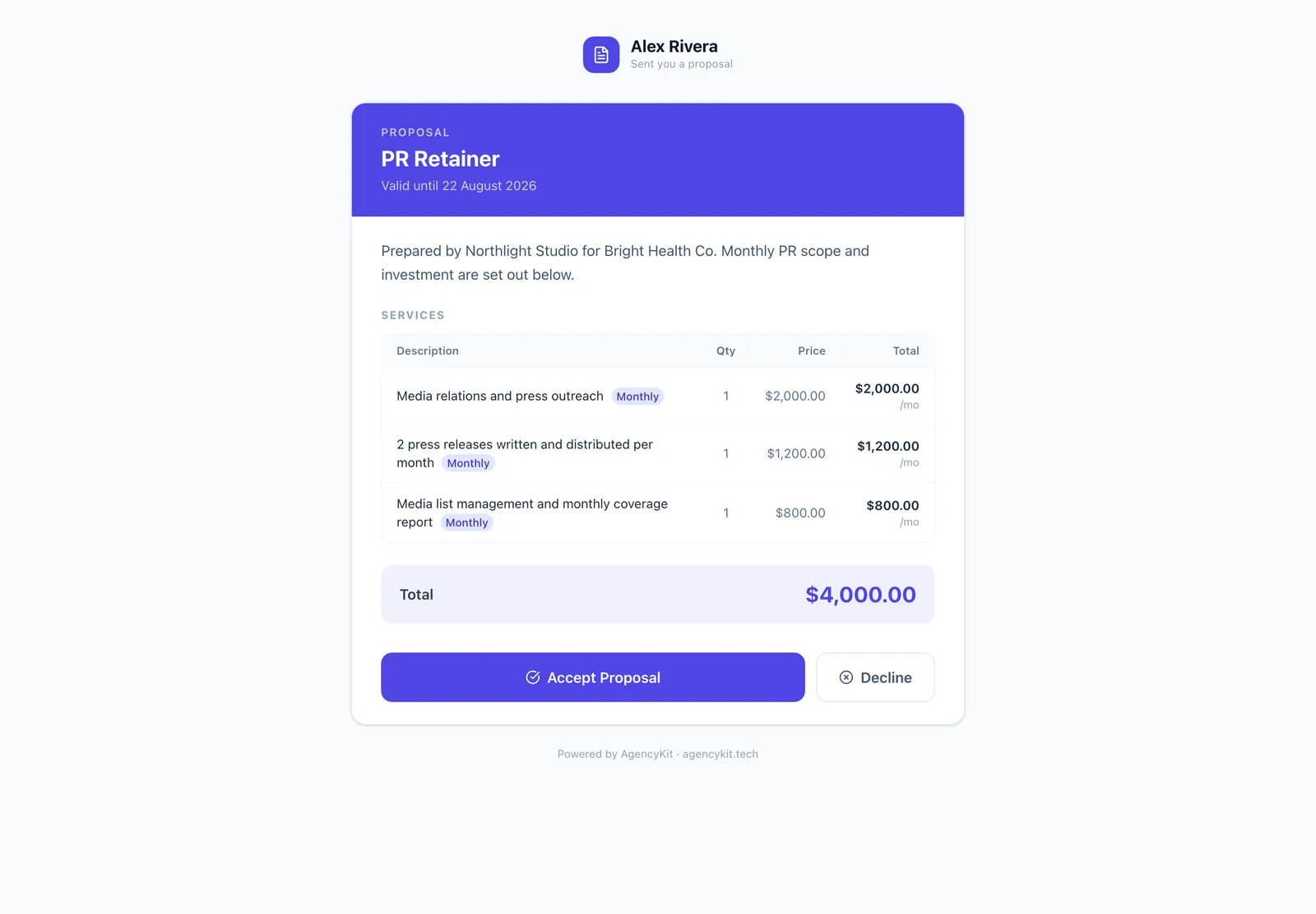
A PR retainer should pay you predictably every month. In AgencyKit, the agreed retainer invoices automatically on the same day each month, and reporting, approvals, and the agreement live in one branded place. Per-account pricing covers the whole team. See AgencyKit for agencies.
Wrapping Up
A PR retainer agreement turns the long, relationship-driven work of media relations into a stable engagement. Set the fee and put the results clause in writing, keep client approvals in the agreement, set a minimum term, and quote events and crises separately. Then bill it automatically. Copy the template, set your terms, and run PR on retainers that give the work the time it needs and pay you reliably.
Pair it with the PR scope of work template for the activity, and read what a retainer agreement should include.
Key Takeaways
- PR runs on a retainer because it builds over months, so the agreement governs a long engagement
- The results clause is essential: commit to activity and outreach, not to guaranteed coverage
- Keep client approvals in the retainer so nothing goes out unapproved
- Set a minimum term to give PR the time it needs, and quote events and crisis work separately
- Bill the retainer automatically, with reporting and approvals in one place and per-account team pricing
Frequently Asked Questions
A PR retainer agreement is the document that sets the commercial terms of an ongoing engagement: the monthly fee, the activity it covers, the results clause, client approvals, the minimum term, scope changes, and cancellation. It works alongside a scope of work, which lists the monthly activity, while the retainer agreement governs the money, the term, and how coverage and results are treated.
The client pays a set monthly fee for ongoing PR activity, media relations, press releases, media list management, and reporting, detailed in a scope of work. The agency commits to consistent outreach, not guaranteed coverage, and reports monthly. Because PR builds over time, retainers usually have a minimum term. A PR retainer gives the agency predictable income and the client a steady, professional media presence.
No, and the agreement should state so clearly. Whether a story runs is decided by journalists and editors based on news value, timing, and their own judgment, none of which the agency controls. A PR retainer should commit to consistent, professional outreach and activity, and state that specific coverage is not guaranteed. Committing to activity rather than coverage is honest and standard, and any agency guaranteeing placements should be viewed with caution.
Three months is a common minimum, and longer is often better, because PR builds relationships and momentum over time. Journalists get to know a spokesperson, coverage builds on earlier stories, and outreach compounds. A short engagement rarely gives that a chance to work, so a minimum term aligns the client with the timeline PR needs and protects the early investment before results are visible.
The scope of work lists the monthly PR activity: outreach, press releases, media list work, and reporting. The retainer agreement sets the commercial terms around it: the fee, the results clause, approvals, the minimum term, scope changes, and cancellation. Keeping them separate lets you adjust the activity without rewriting the whole agreement, and keeps each document focused on its job.
Launches and crisis work are usually kept out of the standard retainer and quoted separately, and the agreement should say so. A standard PR retainer covers proactive media relations, while event management and crisis communications are intensive, unpredictable work that can consume a month’s capacity. Naming them as out of scope, with a small crisis allowance if you offer one, keeps the retainer focused and protects your team’s time.
Automate it. Set the retainer to invoice on the same day each month, ideally in advance, so a long-running engagement is not held up by manual invoicing. In an all-in-one platform the agreed retainer invoices on schedule, and reporting, approvals, and the agreement live in one branded place, with per-account pricing covering the team. Running the retainer in one place keeps income predictable and the admin minimal.
Reading this in Google? You can tell it to show AgencyKit to you more often.
Sources & References
- U.S. Small Business Administration, contracts and getting paid guidance. sba.gov
- AgencyKit retainers, invoicing & reporting (2026). agencykit.tech
- AgencyKit for agencies (2026). agencykit.tech