What Is a PR Scope of Work?
A scope of work for public relations defines what the agency does each month, media outreach, press releases, media list building, reporting, and, crucially, what it is not promising. PR shares SEO’s central challenge: clients often expect guaranteed coverage, but whether a journalist writes a story is the journalist’s decision, not the agency’s. A clear scope sets the activity you commit to and separates it from an outcome no honest agency can guarantee.
The heart of a PR scope is the results clause. Get the line right between committing to consistent, professional outreach and promising specific coverage, and the relationship stays healthy even in a quiet month for placements.
The Free PR Scope of Work Template
Here is a full PR scope you can copy and adapt. A PR scope sets the monthly deliverables, the approval process, and the all-important results clause. Replace everything in [brackets].
2. Objective. Build [media coverage and brand awareness] for the Client in [the target media and sectors].
3. Monthly deliverables.
• Media relations: ongoing outreach and pitching to [the target outlets and journalists].
• Press releases: [2] written and distributed per month.
• Media list: building and maintaining the target media list.
• Reporting: a monthly coverage report with results and pickups.
• [Spokesperson preparation and messaging support.]
4. Results. Media coverage is decided by journalists and editors, not the Agency. The Agency commits to consistent, professional outreach and activity, not to guaranteed placements or specific coverage.
5. Approvals. All statements, quotes, and press releases are approved by the Client before distribution.
6. Out of scope. Paid placements and advertising, sponsored-content fees, event management, crisis communications beyond [an agreed allowance], and channels not listed. These are quoted separately.
7. Client responsibilities. Spokesperson availability, timely approvals, and the information and access the Agency needs to pitch effectively.
8. Term. An initial [3] month minimum, since PR builds over time, then continuing monthly with [30] days notice.
9. Payment. [$X,XXX] per month, billed on the [1st], due in advance.
Signed: [Agency] __________ [Client] __________ Date: __________
Commit to activity, not to coverage
The defining line in a PR scope is that you commit to consistent outreach and professional activity, not to guaranteed placements. Whether a story runs is up to editors and journalists, driven by news value and timing you do not control. State this plainly, and you protect yourself from being judged on a quiet news month while still being accountable for the work you actually do.
What a PR Scope Must Define
A few sections carry the weight in a PR scope.
The monthly activity. Name the deliverables: outreach, the number of press releases, media list work, and reporting. Named deliverables show the client the consistent effort they are paying for.
The results clause. Commit to activity and best-effort outreach, and state that coverage is decided by the media. The results clause is the most important clause in a PR agreement.
Approvals. All statements and releases are approved by the client before they go out, which protects the client’s message and the agency alike.
Out of scope. Paid placements, sponsored content, events, and crisis work beyond an allowance are separate. Naming them keeps the retainer to proactive media relations.
Turn the Scope Into a Signed Retainer
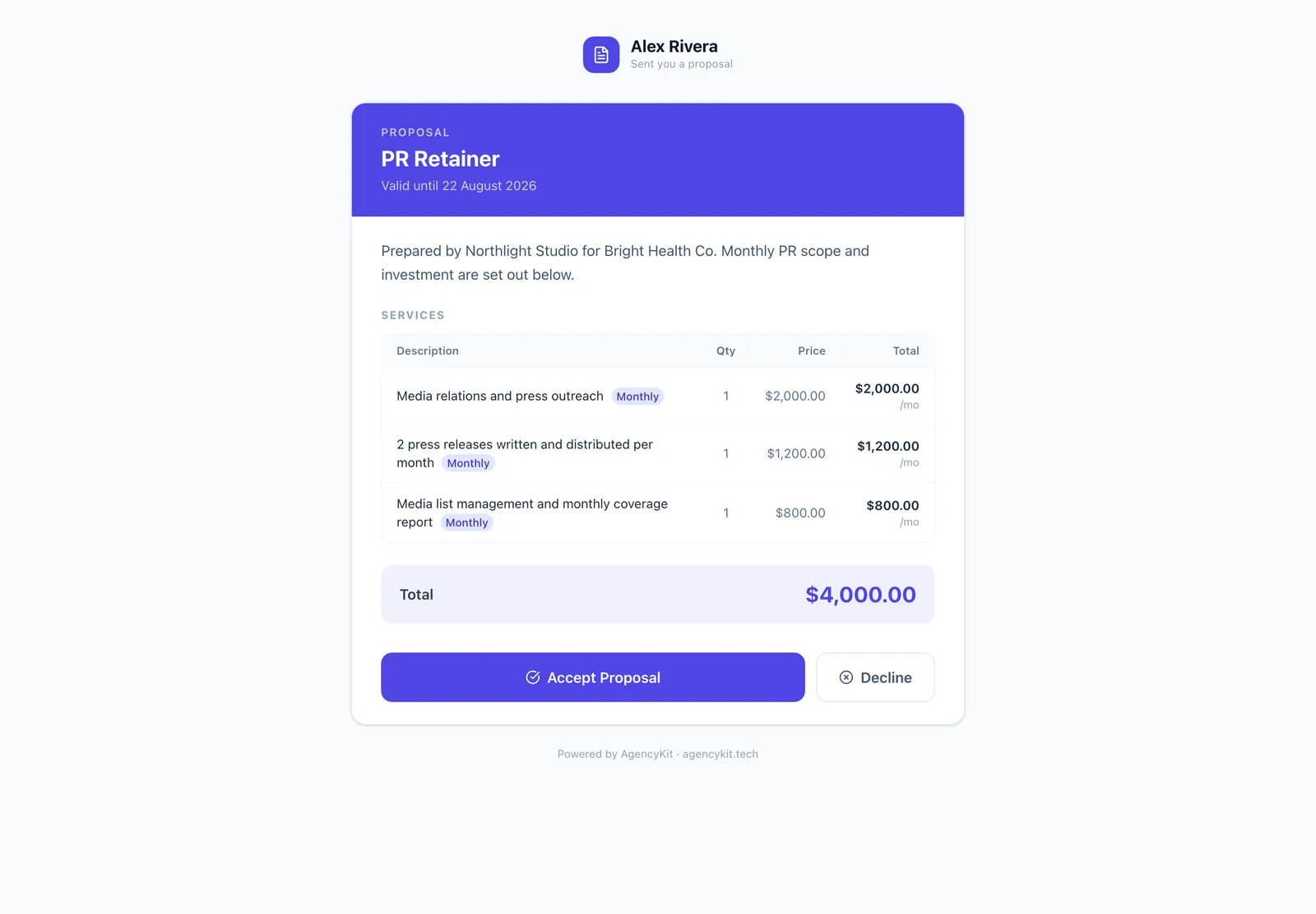
PR is ongoing and builds over time, so it runs on a retainer. In AgencyKit, you present the scope as a branded proposal, sign a contract, and run the monthly fee as a retainer that invoices automatically, with reporting and approvals in one place. See AgencyKit for agencies.
Wrapping Up
A PR scope of work protects the relationship against the one thing that strains PR engagements: a mismatch on coverage. Name the monthly activity, commit to outreach rather than guaranteed placements, build in approvals, and keep paid and crisis work out of scope. Then present it as a proposal and run it as a retainer. Copy the template, set your terms, and take on PR with expectations set straight.
Next, set the commercial terms with the PR retainer agreement template, and see how to stop scope creep.
Key Takeaways
- A PR scope of work names the monthly activity (outreach, releases, media list, reporting) and what is not promised
- The results clause is essential: commit to activity and outreach, not to guaranteed coverage
- Build in approvals so all statements and releases are signed off by the client before distribution
- Keep paid placements, events, and crisis work out of the standard retainer, quoted separately
- Set a minimum term because PR builds over time, then present the scope as a proposal and run it as a retainer
Frequently Asked Questions
A PR scope of work is the document that defines what a PR agency delivers each month, media outreach and pitching, press releases, media list building, reporting, and often spokesperson support, and what it is not promising. Critically, it commits the agency to consistent, professional activity rather than to guaranteed coverage, since whether a story runs is the media’s decision, not the agency’s.
Name the monthly deliverables (outreach, number of press releases, media list work, reporting), include a results clause committing to activity rather than guaranteed placements, set the approval process for statements and releases, list what is out of scope (paid placements, events, crisis work beyond an allowance), state the client’s responsibilities such as spokesperson availability, and set the minimum term and fee.
No, and the scope should say so clearly. Whether a journalist or outlet runs a story depends on news value, timing, and editorial decisions the agency does not control. A good PR agency commits to consistent, professional outreach and activity, and states that specific coverage is not guaranteed. Any agency promising guaranteed placements in reputable media should be treated with caution.
The client pays a set monthly fee for ongoing PR activity: media relations, a set number of press releases, media list management, and reporting, detailed in a scope of work. PR builds over time, so retainers usually have a minimum term. The agency commits to consistent outreach, not guaranteed coverage, and reports on results each month. A monthly retainer gives the agency predictable income and the client a steady media presence.
Because PR builds relationships and momentum over time, and a short engagement rarely gives that a chance to pay off. Journalists get to know a spokesperson, stories build on earlier coverage, and outreach compounds. A minimum term, often three months, aligns the client with the timeline PR actually needs and protects the early investment before results become visible.
Typically paid placements and advertising, sponsored-content fees, event management, crisis communications beyond an agreed allowance, and any channel not named in the scope. A standard PR retainer covers proactive media relations, so listing these separately keeps the fee focused on outreach and reporting, and turns bigger needs like a crisis or an event into separately scoped, quoted work.
Present it as a branded proposal the client accepts online, with the monthly activity, results clause, and fee laid out, then sign a contract and run it as a monthly retainer that invoices automatically. Keep reporting and approvals in one place. In an all-in-one tool the accepted proposal flows into a contract and recurring invoice, so the engagement is set up cleanly and paid predictably.
Reading this in Google? You can tell it to show AgencyKit to you more often.
Sources & References
- U.S. Small Business Administration, contracts and scope guidance. sba.gov
- AgencyKit proposals, contracts & retainers (2026). agencykit.tech
- AgencyKit for agencies (2026). agencykit.tech