What Is a Social Media Agency Retainer Agreement?
A retainer agreement is what makes an agency a business rather than a series of projects. A retainer agreement sets the commercial terms of the ongoing relationship: the monthly fee, how ad spend is handled, the minimum term, account management, and the rules for changes and cancellation. Where the scope of work lists what the agency delivers, the retainer agreement governs the money and the term around it.
For a social media agency, the retainer is the whole model. Predictable monthly revenue is what lets you hire, plan capacity, and invest in a client's results over time instead of living project to project. The agreement is what protects that predictability on both sides.
The Free Social Media Agency Retainer Template
A complete agency retainer agreement to copy and adapt: It handles the pieces that matter most for agencies: ad spend, account management, a minimum term, and scope changes. Replace everything in [brackets].
2. Monthly retainer fee. [$X,XXX] per month, covering the services and deliverables in the attached scope of work.
3. Services included. [Content production, community management, paid social management, monthly strategy and reporting], as detailed in the scope of work.
4. Ad spend. The retainer fee is for management only. Ad spend is [billed separately / paid directly by the Client to the platforms] and is not part of the fee.
5. Account management. A dedicated account manager ([role]) and [one] monthly strategy call are included. Requests go through [one agreed channel].
6. Payment. Billed on the [1st] of each month, due [on receipt]. The first month is paid before onboarding begins.
7. Minimum term and renewal. An initial [3] month term, after which the retainer continues month to month, renewing automatically until cancelled.
8. Unused work. Deliverables and hours reserved each month do not roll over. Capacity is held for the Client whether or not it is fully used.
9. Scope changes and extra work. Adding a platform, service, or campaign is quoted and agreed in writing before it starts. Fees are reviewed [once a year] with [30] days notice.
10. Cancellation. After the minimum term, either party may cancel with [30] days written notice. The final month is worked and paid in full, and account access is handed back on completion.
Signed: [Agency] __________ [Client] __________ Date: __________
The ad-spend clause is the one to get right
More agency retainer disputes come from ad spend than anything else. Your clause must make it unmistakable that the monthly fee is for management, and that the ad budget is separate money, either invoiced on its own or paid by the client directly to the platform. Never fold ad spend into the retainer fee, and never front it without a written agreement.
The Clauses That Protect an Agency Retainer
Beyond the fee, a handful of terms keep an agency retainer healthy.
Minimum term. An initial three-month term (sometimes six) protects the heavy ramp-up: onboarding, audits, pipelines, and paid campaigns that take weeks to work. A minimum term also signals to the client that results are a commitment, not a trial.
Scope-change process. Agencies grow accounts, and clients ask for more. A clause that says any new platform, service, or campaign is quoted and agreed in writing before it starts turns growth into billed revenue instead of scope creep.
Capacity and rollover. State that reserved hours and deliverables do not roll over. An agency sells capacity, and that capacity is held for the client each month whether or not they use every hour.
Handover on cancellation. Spell out that on cancellation, after the notice period and final payment, account access and assets are handed back cleanly. A clean handover protects your reputation and makes you the agency clients recommend.
Bill the Retainer Automatically, Manage the Account in One Place
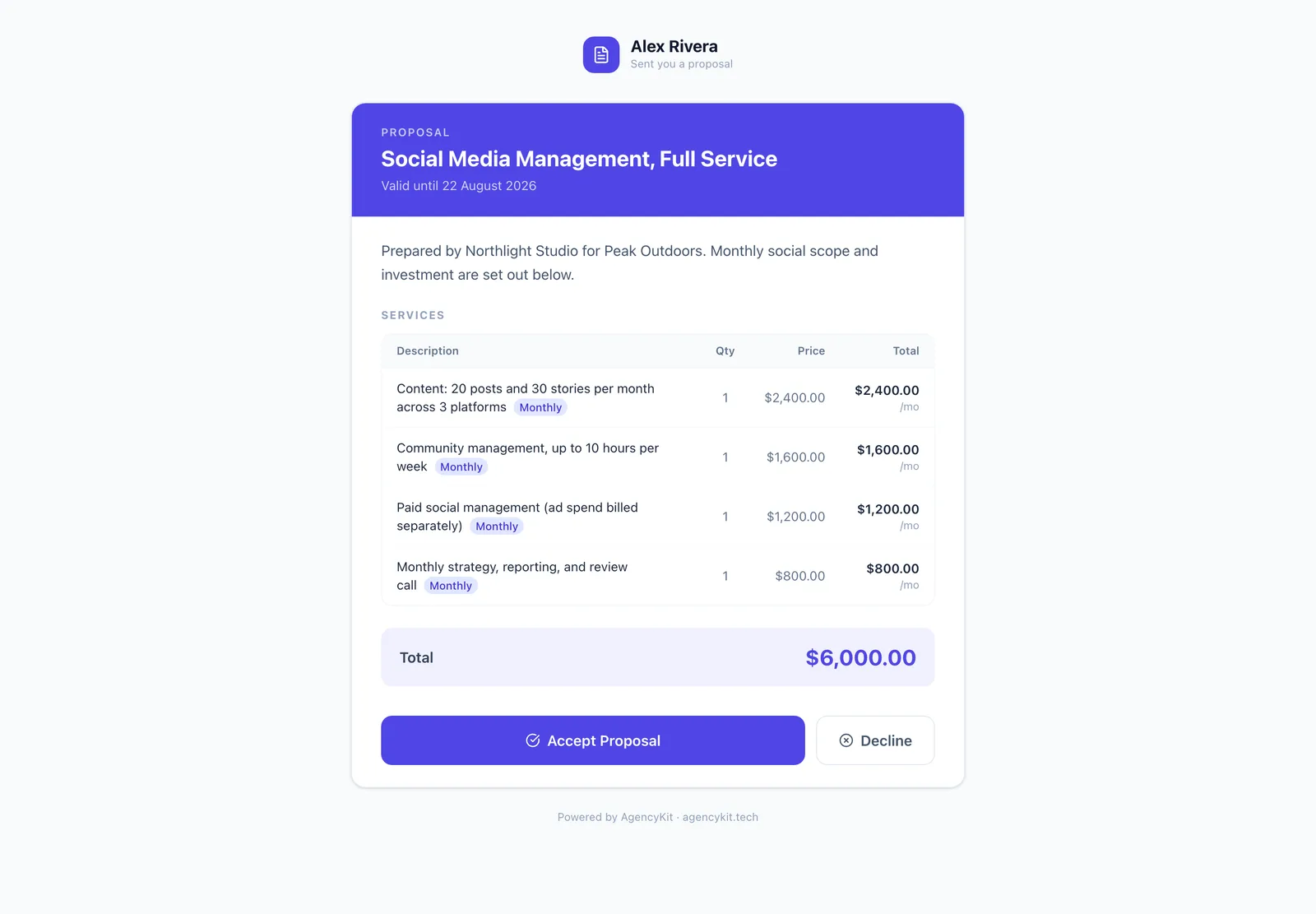
Agency retainers should not depend on someone remembering to invoice. In AgencyKit, the agreed retainer invoices automatically each month, your team works the account from tasks and a client portal, and reports and approvals live in one branded place. Because pricing is per account rather than per seat, the whole team is covered as you grow. See AgencyKit for agencies.
Wrapping Up
A social media agency retainer agreement is what turns good work into a durable business. Set the fee and keep ad spend firmly separate, add a minimum term to protect the ramp-up, write a scope-change process so growth is billed, and define a clean handover on cancellation. Then bill it automatically so revenue is predictable. Copy the template, set your terms, and build the agency on retainers that run themselves.
Pair it with the agency scope of work template for the deliverables, and read what a retainer agreement should include.
Key Takeaways
- A retainer agreement sets the commercial terms (fee, ad spend, term, cancellation) while the scope of work lists the deliverables
- The ad-spend clause is the one to get right: the fee is for management, the ad budget is separate money
- A three-month minimum term protects the agency ramp-up and signals client commitment
- A written scope-change process turns account growth into billed revenue instead of scope creep
- Bill the retainer automatically and manage the whole account in one place, with per-account pricing covering the team
Frequently Asked Questions
A social media agency retainer agreement sets the commercial terms of an ongoing agency-client relationship: the monthly fee, how ad spend is handled, the services included, the minimum term, account management, and the rules for scope changes and cancellation. It works alongside a scope of work, which lists the deliverables, while the retainer agreement governs the money and the term around them.
Keep it entirely separate from the retainer fee. The agreement must state that the monthly fee covers managing campaigns, while the ad spend is the client’s money, either invoiced separately or paid directly by the client to the platforms. Ad spend is the single most common source of agency retainer disputes, so make the split unmistakable and never fold ad budget into your fee.
Three months is the common standard, and some agencies use six for more involved work. Agency social work has a real ramp-up, onboarding, audits, building content pipelines, and optimizing paid campaigns, that takes weeks to pay off. A minimum term protects that investment and signals to the client that results require commitment. After it, the retainer usually continues month to month.
With a written change process in the agreement. State that adding a platform, a service, or a campaign is quoted and agreed in writing before work begins. Quoting every addition in writing turns account growth into billed revenue rather than scope creep, and keeps the relationship clean, because the client always knows that more work means an agreed adjustment, not an assumed freebie.
The scope of work lists what the agency delivers each month: services, platforms, deliverable counts, and approvals. The retainer agreement sets the commercial terms around those deliverables: fee, ad-spend handling, minimum term, account management, scope changes, and cancellation. Keeping them separate lets you adjust deliverables without rewriting the whole agreement.
Usually not, and the agreement should say so. An agency sells reserved capacity, held for the client each month whether or not every hour is used, so unused hours and deliverables typically do not carry over. Stating this prevents a quiet month from becoming a demand for double the work later. If you allow any rollover, cap it tightly, for example at one month.
Automate it. Rather than raising invoices by hand, set the retainer to invoice on the same day each month, ideally at the start before the work. In an all-in-one platform the agreed retainer invoices on schedule, the team manages the account from shared tasks and a client portal, and everything sits in one place. That keeps revenue predictable and removes the monthly admin.
Define a clean exit in the agreement: after the notice period (commonly 30 days) and the final payment, account access and assets are handed back to the client. A tidy handover protects your reputation and makes you the agency clients recommend, even when they leave. Spell it out so the end of a relationship is orderly rather than a scramble.
Reading this in Google? You can tell it to show AgencyKit to you more often.
Sources & References
- U.S. Small Business Administration, contracts and getting paid guidance. sba.gov
- AgencyKit retainers, invoicing & client portal (2026). agencykit.tech
- AgencyKit for agencies (2026). agencykit.tech