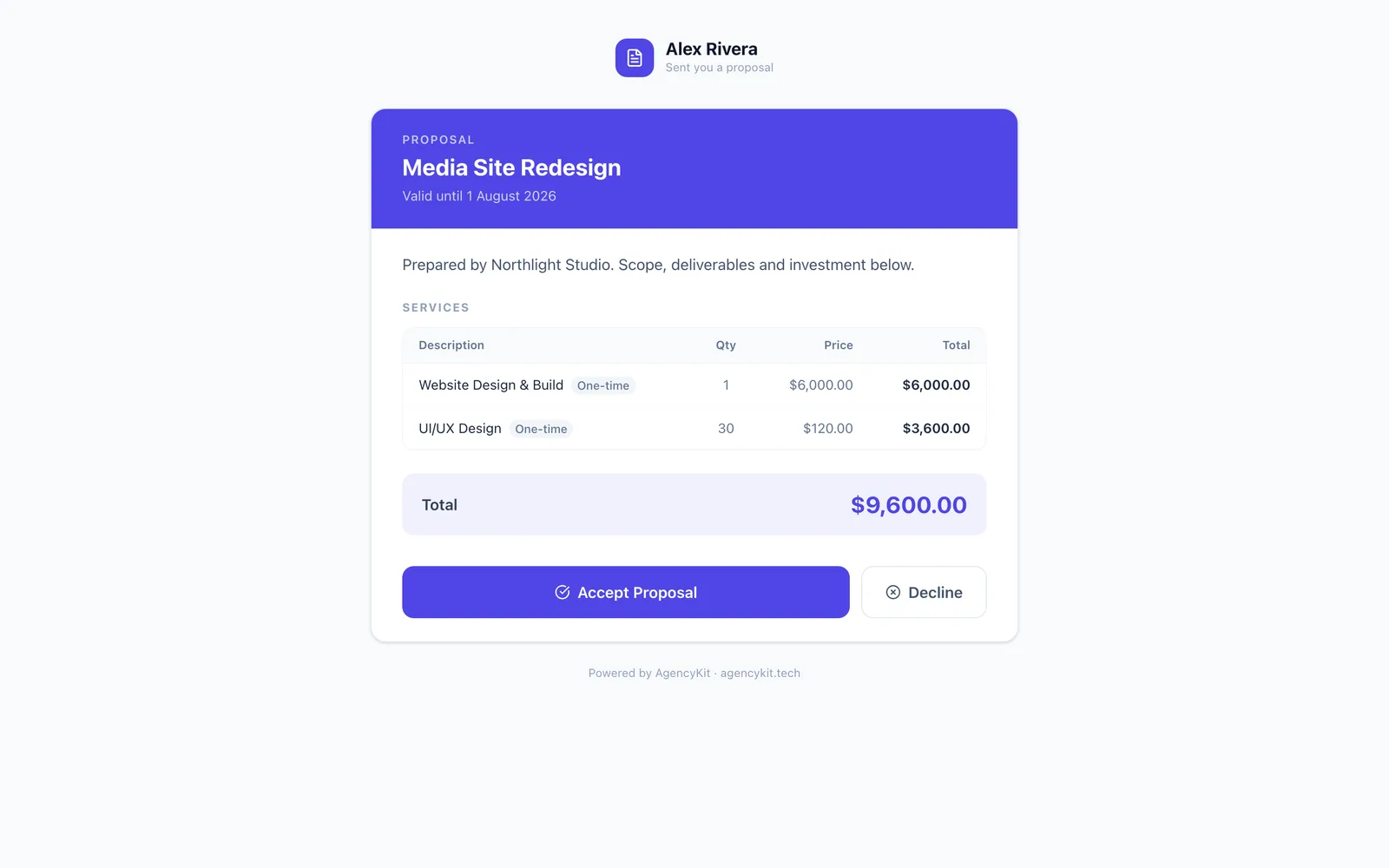
What Is a Social Media Proposal?
A social media proposal is the document you send to win a social media management client: it reads their current presence, sets goals tied to a business result, and lays out exactly what you will post, manage, and report each month, for a monthly fee. The proposals that win are specific about volume and process, and honest about which goals social media can and cannot move.
What a Social Media Proposal Should Include
Vague social proposals lose to specific ones. Cover:
- Where they are now, a quick read on their current presence.
- Goals, tied to a business result, not vanity metrics.
- Scope of work, platforms, post volume, content types, community management, and ads.
- Content and approval process, so there are no surprises.
- Reporting, tied to the goals.
- Investment, a monthly retainer, with ad spend handled as a pass-through cost.
The Social Media Proposal Template
Copy this, fill in the specifics for the client, and send it.
Prepared by [Your agency], [date]. Valid for 30 days.
[A quick read on their current social presence: platforms, posting consistency, engagement, and the gap between where they are and where they want to be.]
[What success looks like: awareness, engagement, followers, leads, or sales. Tie it to a business result, not vanity metrics.]
[The specifics: which platforms, how many posts a month, content types (graphics, video, stories), community management and response times, and whether paid ads are included. Note what is out of scope.]
[How content is planned, drafted, approved, and scheduled. For example: monthly content calendar for approval, then scheduling.]
[What you report and how often, tied to the goals in section 2.]
[Your monthly retainer and what it includes, plus any ad spend handled separately as a pass-through cost.]
[A clear way to accept and a start date.]
Be specific about volume and community management
The two things clients most often misunderstand are how many posts they get and whether you reply to comments and messages. Spell out the exact number of posts a month by type, and define community management with a response-time commitment, so the retainer scope is unmistakable and you avoid over-servicing.
How to Use the Social Media Proposal
What happens after they say yes. The template above stops at "sent". In AgencyKit a proposal the client accepts online becomes a contract for signature and then the first invoice, carrying the same line items and the same monthly fee, so the number you quoted is the number you bill. A monthly social retainer can also be set up as a package that invoices itself at month end. Proposals and contracts start on the $9 Starter plan; electronic signature and online payment are on the $39 Agency plan.
Keep ad spend separate from your fee. Your retainer is for your work; the client’s ad budget is a pass-through cost that should never be counted as your revenue. Define post volume and community management precisely so the scope is clear and you do not quietly over-service.
In AgencyKit, build this in the free proposal generator, or send a branded proposal the client accepts online that becomes a recurring monthly retainer invoice automatically.
Related Guides
See the free proposal generator, the SEO proposal template, the social media retainer agreement, and the social media scope of work.
Key Takeaways
- A social media proposal reads the current presence, sets goals, and scopes the monthly work
- Be specific about post volume, content types, and community management to avoid over-servicing
- Tie goals to a business result, not vanity metrics like follower counts alone
- Price it as a monthly retainer and keep the client’s ad spend as a separate pass-through cost
- AgencyKit turns an accepted social proposal into a recurring monthly retainer invoice
Frequently Asked Questions
A social media proposal should include a read on the client’s current presence, goals tied to a business result, the scope of work (platforms, post volume, content types, community management, ads), the content and approval process, reporting, and the investment as a monthly retainer.
Social media management is priced as a monthly retainer based on the scope: the number of platforms, posts, and content types, plus community management. Keep the client’s ad spend separate as a pass-through cost, not part of your fee.
There is no fixed number of posts; it depends on the platforms and content types. What matters is being specific in the proposal, for example twelve feed posts and eight stories a month, so the client knows exactly what the retainer covers and you avoid over-servicing.
List ad spend separately from your management fee. The client’s ad budget is a pass-through cost paid to the platforms, so it should never be counted as your agency revenue. Your fee is for managing the work, not for the media.
Four things, and leaving them out is where most social media management proposals lose money. The exact post count and which platforms, because "regular content" means something different to each of you. Whether video is included, since a reel costs several times what a static graphic costs. Who writes the captions. Whether ad spend management is inside the fee or billed separately, which is normally a percentage of spend rather than part of the retainer. Everything else in a social marketing proposal is standard proposal work.
In AgencyKit an accepted proposal becomes a contract for signature and then the first invoice, carrying the same line items and the same monthly fee, so the figure you quoted is the figure you bill. A recurring social retainer can be set up as a package that invoices itself at month end. Proposals and contracts start at $9 a month; electronic signature and online payment are on the $39 Agency plan.
Reading this in Google? You can tell it to show AgencyKit to you more often.
Sources & References
- AgencyKit proposals and retainers (2026). agencykit.tech