What Is a Social Media Manager Scope of Work?
A scope of work (SOW) for a social media manager is a short document that spells out exactly what you will deliver each month: which platforms, how many posts, what community management and reporting are included, and, just as importantly, what is not. The scope is the backbone of the agreement, the part that turns a vague "manage our socials" into a clear, priced set of deliverables.
For a social media manager, the SOW is the single best defence you have against scope creep. Social work is uniquely prone to it, because there is always one more comment to reply to, one more platform to add, one more "quick" graphic. A written scope gives you a calm, professional way to hold the line. A scope of work is different from a full contract, which carries the legal terms, but the two usually live together, and often the SOW sits inside the contract or the proposal.
The Free Social Media Manager Scope of Work Template
A complete social media scope of work you can copy and adapt: Replace everything in [brackets] with your own numbers and terms. The template is specific enough to protect you and simple enough to actually use.
2. Platforms covered. The Provider will manage these platforms only: [Instagram, LinkedIn]. Any other platform (for example TikTok, X, Pinterest, YouTube) is out of scope unless added in writing.
3. Monthly deliverables.
• Content: [12] feed posts and [15] stories per month, split across the platforms above.
• Formats: [static graphics, carousels, and short-form video].
• Captions and hashtags written by the Provider for every post.
• Community management: replying to comments and direct messages, up to [5] hours per week, on business days.
• Reporting: one monthly report covering [reach, engagement, follower growth, and top posts], plus a [30] minute review call.
4. Content approval. The Provider shares content for approval [7] days before it is scheduled. The Client approves or requests changes within [2] business days. Content not reviewed in time is published as drafted.
5. Revisions. Each piece of content includes [one] round of revisions. Further rounds, or changes after approval, are billed at [$XX] per hour.
6. Out of scope. Not included, and quoted separately: paid ad management and ad spend, influencer outreach, photo or video shoots, website or blog content, and any platform not listed in section 2.
7. Client responsibilities. The Client provides brand assets, product information, and approvals on time. Delays may move deliverables to the following month.
8. Payment. The monthly fee is [$X,XXX], billed on the [1st] of each month, due [on receipt]. Work begins once the first payment is received.
9. Term and termination. Either party may end this agreement with [30] days written notice. Work delivered or in progress remains payable.
Signed: [Provider] __________ [Client] __________ Date: __________
Fill in every bracket before you send it
An empty bracket is a future argument. The value of this template is the numbers you put in it, the exact post counts, the hours, the notice period, so take ten minutes to set them per client rather than sending a half-filled draft. A specific scope is what makes it enforceable.
What to Include, Section by Section
A social media SOW is only as strong as its detail. What each section should nail down for this kind of work specifically:
Platforms, by name. Never write "social media". Write "Instagram and LinkedIn". The moment you leave it open, TikTok, X, and Pinterest quietly become your problem. List the exact platforms, and put everything else out of scope.
Content volume, in numbers per platform. "Regular posting" means nothing. State the count: for example 12 feed posts and 15 stories a month. If the mix differs per platform, break it down. The post count is the number the whole agreement hangs on.
Content formats. A carousel and a reel are not the same amount of work. Say which formats are included (static, carousel, short-form video) so a client cannot expect five reels a week under a static-post budget.
Community management, defined or excluded. Community management is the biggest hidden cost in social work. Either define community management (reply to comments and DMs, up to a set number of hours per week, on business days, with a response-time expectation) or exclude it outright. Do not leave "engagement" floating.
Ad management, usually out. Running paid ads is a separate skill and a separate spend. Unless you are being paid to manage campaigns, put ad management and ad spend explicitly out of scope so "can you just boost this" does not become unpaid work.
Reporting and approvals. State what the monthly report covers and how often, and set the approval loop: how far ahead you share content, how long the client has to respond, and what happens if they miss the window.
Define Deliverables in Numbers, Not Adjectives
If you take one thing from this page, take this. Vague language is what lets a fixed fee turn into unlimited work. Every deliverable should be a number or a clear boundary, not an adjective.
| Vague (invites scope creep) | Specific (a real scope) |
|---|---|
| Manage our Instagram | 12 feed posts and 15 stories per month on Instagram |
| Handle community engagement | Reply to comments and DMs, up to 5 hours per week, on business days |
| Provide reporting | One monthly report on reach, engagement, and follower growth, plus a 30-minute call |
| Create content | Static graphics, carousels, and short-form video, with one revision round each |
The specific column is not colder or less friendly. A specific scope is what lets you say yes to the work with confidence, and it is what a good client actually wants, because they know exactly what they are paying for.
How the Scope of Work Stops Scope Creep
Picture the usual requests. "Can you also start posting on TikTok?" "Can you reply to DMs on weekends?" "Can you design the ad creatives too?" "Can we jump on a call every morning?" Without a scope, each one feels like a small favour, and together they eat your margin. With a scope, each one has a simple, professional answer: "That sits outside our current scope. I can add it, here is what it would cost." Section 2 handles the new platform, section 6 handles the ad creatives, and section 3 handles the daily calls. The document does the awkward part for you. For more on protecting your time, see our guide on how to stop scope creep.
A scope is a tool for saying yes, not no
The point of a tight scope is not to refuse work. The point is to make extra work a clear, paid decision rather than a slow leak. When a client asks for more, the scope turns it into a simple quote, which is better for both sides than resentment building over unbilled hours.
Turn Your Scope Into a Signed Proposal and a Paid Retainer
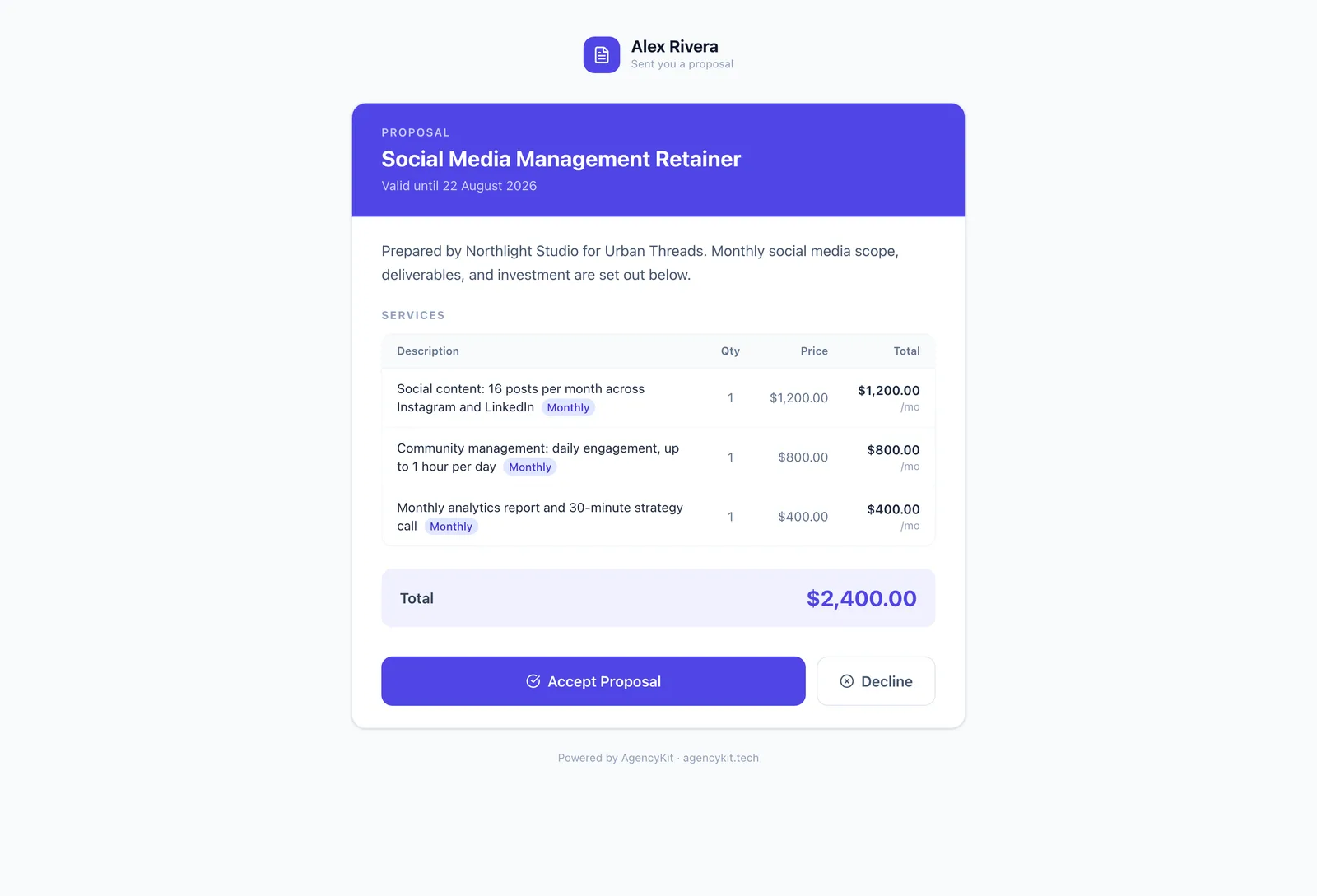
A scope of work sitting in a document does half the job. The other half is getting it accepted and getting paid on time, every month. That is where a tool helps. In AgencyKit, you put the scope into a proposal the client can accept online, it flows into a contract with the same terms, and the monthly fee becomes a retainer that invoices automatically. The screenshot above is exactly that: a social media scope, itemized as monthly deliverables, ready for the client to approve. For the wider setup, see AgencyKit for social media managers.
Wrapping Up
A social media manager scope of work is your best protection against the slow creep that turns a healthy retainer into unpaid overtime. Name the platforms, state the deliverables in numbers, define or exclude community management and ads, set the approval loop, and put everything else out of scope. Copy the template above, fill in every bracket, and turn it into a proposal the client signs. Do that and every month starts with both sides knowing exactly what "done" looks like.
Next, lock in the money side: read what a retainer agreement should include, and grab the free contract template to wrap around your scope.
Key Takeaways
- A social media scope of work defines exactly what you deliver each month, and is the single best defence against scope creep
- Name the platforms by hand, and put every unlisted platform out of scope
- State deliverables in numbers, not adjectives: exact post counts, capped community-management hours, defined reporting
- Put paid ad management and ad spend explicitly out of scope unless you are hired for campaigns
- Turn the scope into a proposal the client accepts online, then a retainer that invoices automatically, so getting paid each month is hands-off
Frequently Asked Questions
A social media scope of work is a short document that defines exactly what a social media manager will deliver, usually each month: which platforms are covered, how many posts and stories, whether community management and reporting are included, the approval process, and what is out of scope. A scope of work turns a vague "manage our socials" into a clear, priced set of deliverables that both sides agree to up front.
Name the platforms exactly, the monthly content volume in numbers per platform, the content formats, community management (defined by hours or excluded), reporting cadence, the approval and revision process, an out-of-scope list (usually ads, shoots, and extra platforms), client responsibilities, the monthly fee and billing date, and a termination notice period. Specific numbers matter more than polished wording.
The scope of work defines the "what and how much": the deliverables, quantities, and boundaries of the job. The contract carries the legal terms: payment, liability, ownership, termination, and so on. A scope and a contract usually go together, with the scope sitting inside or attached to the contract. For a social media manager, the scope is the section clients read most closely, because it is where the monthly deliverables live.
There is no single right number, and that is exactly why you must state yours. Packages commonly range from around 8 to 20 feed posts a month per platform, often with a set number of stories on top, but it depends on your rate, the platforms, and the formats (a reel takes far longer than a static post). The important thing is to fix the number in the scope rather than leave it open.
Only if it is clearly defined, otherwise it becomes the biggest hidden cost in social work. If you include it, cap it: for example, replying to comments and DMs up to a set number of hours per week, on business days, with an agreed response time. If you do not want to own it, exclude it explicitly. What you must not do is leave "engagement" or "community" floating with no boundary.
Ad spend should not be included, unless you are specifically hired to manage campaigns. Running paid ads is a separate skill, and the ad spend itself is the client’s money, not your fee. Put both ad management and ad spend explicitly out of scope in the SOW, and quote them separately if the client wants them. Excluding ads stops "can you just boost this post" from turning into unpaid campaign work.
You do not stop them asking, you make each request a clear decision. A scope of work with a named platform list, defined deliverables, and an out-of-scope section lets you answer any extra ask the same calm way: "That is outside our current scope, I can add it, here is the cost." The document does the awkward part, so a new request becomes a quick quote instead of a slow, unbilled leak.
Put the scope into a proposal the client can accept online, so the agreed deliverables and monthly fee are locked in with their acceptance. Convert that into a contract with the same terms, then set the monthly fee as a retainer that invoices automatically on the same day each month. In AgencyKit this whole path runs in one place, so once the scope is accepted, getting paid each month is automatic rather than a fresh invoice every time.
Reading this in Google? You can tell it to show AgencyKit to you more often.
Sources & References
- U.S. Small Business Administration, contracts and scope guidance. sba.gov
- AgencyKit proposals, contracts & retainers (2026). agencykit.tech
- AgencyKit for social media managers (2026). agencykit.tech