What Is a Web Design Scope of Work?
A scope of work for a web design project defines exactly what the website includes, how many revisions come with it, who provides the content, and where the project ends. Web projects are famous for scope creep, the extra page, the "small" feature, the fifth round of design tweaks, and almost all of it traces back to a scope that was too vague at the start. A tight scope is what keeps a fixed-price website from turning into months of unpaid extra work.
Web work also has its own specific traps that a generic scope misses: browser and device testing, who supplies the content, what happens at launch, and where the build ends and ongoing maintenance begins. A web design scope of work names all of them.
The Free Web Design Scope of Work Template
A full website project scope you can copy and adapt: The template covers the details that cause disputes in web work: page count, revision rounds, content responsibility, browsers, and launch. Replace everything in [brackets].
2. Deliverables. A [5] page website: [Home, About, Services, Blog, Contact]. Custom design for [the key page templates], built responsive across [desktop, tablet, and mobile].
3. Functionality. Includes [a contact form, a content management system, a blog, and basic on-page SEO setup]. Third-party integrations: [list them, or state none].
4. Design revisions. [Two] rounds of revisions at the design stage. Further rounds, or changes after design sign-off, are billed at [$XX] per hour.
5. Content. The Client provides [final copy and images]. [Copywriting and photography are quoted separately.] Delays in providing content move the launch date accordingly.
6. Browsers and devices. Tested on the current versions of [Chrome, Safari, Firefox, and Edge] and on [mobile, tablet, and desktop].
7. Launch and handover. Deployed to [the Client's hosting]. [30] days of post-launch bug fixes are included from the launch date.
8. Out of scope. Ongoing maintenance and hosting beyond launch, content writing, ongoing SEO, and any page or feature not listed above. Ongoing care is covered by a separate care plan.
9. Timeline and payment. [X] weeks from a complete brief and content. A [50%] deposit before work begins, with the balance due at launch [or split across milestones].
Signed: [Agency] __________ [Client] __________ Date: __________
Name who provides the content, and mean it
Nothing stalls a website build like waiting on the client's copy and images. Half-finished projects sit for months because the content never arrived. State clearly that the client provides final content by a date, that copywriting and photography are separate if you offer them, and that content delays move the launch. Naming who provides the content is the single most useful line in a web scope.
What a Web Design Scope Must Pin Down
A few sections are where web projects live or die.
Page count and functionality. State the exact number of pages and what each includes, plus the specific functionality (forms, CMS, blog, integrations). "A website" is not a scope. "A five-page site with a contact form and a blog" is.
Design revision rounds. Cap the revisions at the design stage, commonly two rounds, with further rounds billed hourly. Uncapped design feedback is where web budgets quietly disappear.
Content responsibility. Say clearly who provides copy and images, and that delays move the timeline. That one line prevents the most common cause of stalled projects.
Launch and the end of the project. Define what launch means, how long post-launch bug fixes are included, and that ongoing maintenance is a separate care plan. Naming the launch terms is what stops a finished project from becoming unpaid lifetime support.
Turn the Scope Into a Signed Project and a Care Plan
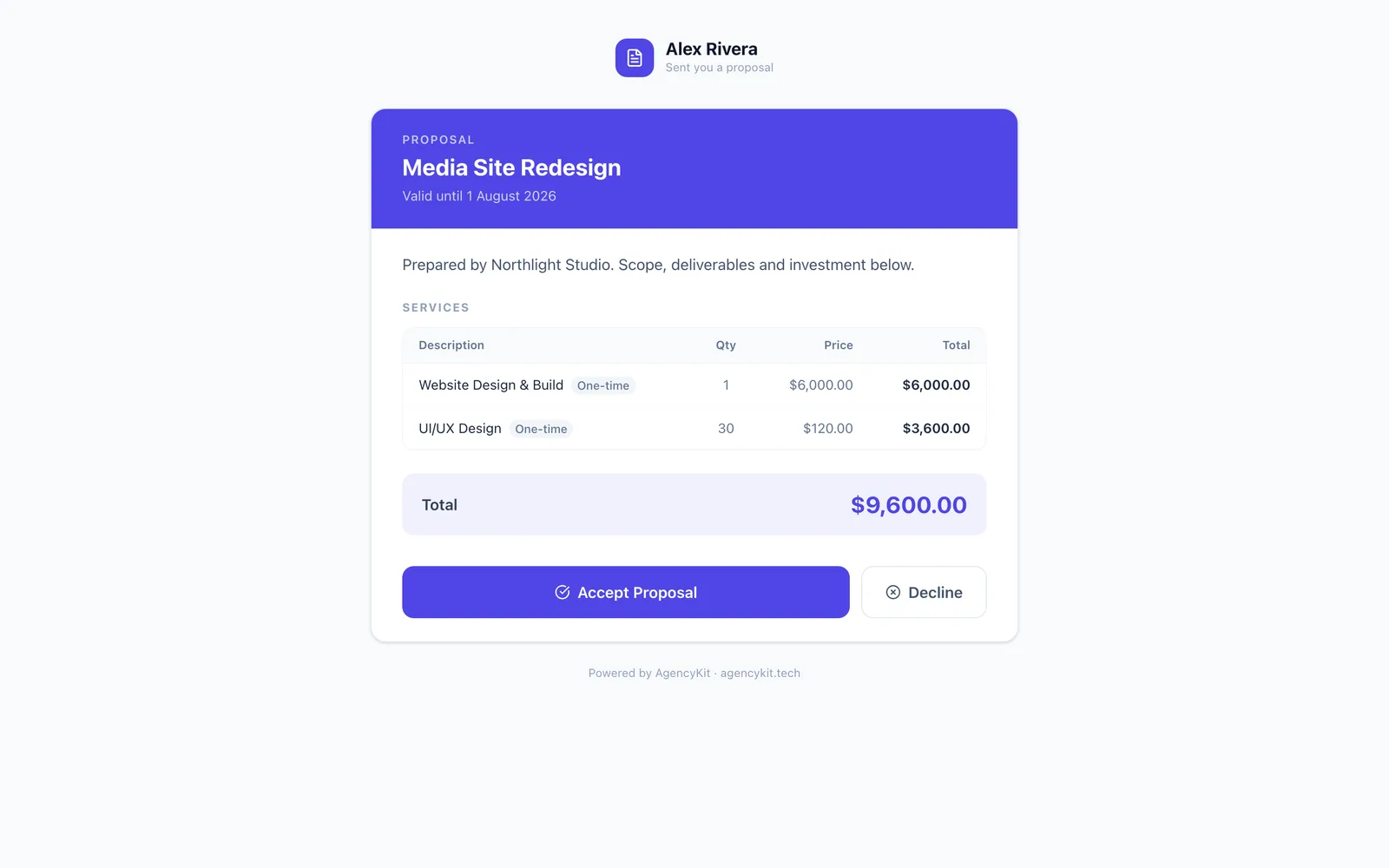
A web scope earns its keep when it is signed, deposited, and billing. In AgencyKit, you present the scope as a proposal the client accepts online, take a deposit, and sign a contract, all in one flow. When the build ships, you move the client onto a website care plan that invoices monthly, turning a one-off project into recurring revenue. See client management software for web designers.
Wrapping Up
A web design scope of work is your defence against the scope creep that plagues website projects. Name the pages and functionality, cap the design revisions, make content responsibility explicit, and define exactly where the build ends and a care plan begins. Then present it as a proposal the client signs with a deposit. Copy the template, set your terms, and take on web projects with a clear finish line instead of an open one.
When the site ships, keep the client with the website care plan template, and see how to stop scope creep.
Key Takeaways
- A web design scope defines the pages, functionality, revisions, content responsibility, and launch, so a fixed price stays fixed
- State the exact page count and functionality: "a website" is not a scope
- Cap design revisions (commonly two rounds) and make content responsibility explicit, since content delays stall most projects
- Define launch and the included post-launch period, and put ongoing maintenance into a separate care plan
- Present the scope as a proposal with a deposit, then move the client onto a care plan when the site ships
Frequently Asked Questions
A web design scope of work is the document that defines exactly what a website project includes: the number of pages and their content, the functionality (forms, CMS, blog, integrations), the number of design revision rounds, who provides the copy and images, the browsers and devices tested, the launch terms, and what is out of scope. A written scope is what keeps a fixed-price website project from expanding into unpaid extra work.
The page count and what each page includes; the functionality and any integrations; the number of design revision rounds; a clear statement of who provides content and that delays move the timeline; the browsers and devices tested; the launch and handover terms including post-launch bug fixes; an out-of-scope list; and the timeline and payment terms, usually a deposit before work with the balance at launch.
Pin down the specifics in the scope and hold to them. State the exact page count and functionality, cap design revisions (commonly two rounds), make content responsibility explicit, and define where the build ends. Then any extra, a new page, another revision round, an added feature, has a simple answer: it is outside the scope and quoted separately. The document turns "small" additions into clear, paid decisions.
Usually the client, and the scope must say so explicitly, because waiting on content is the most common cause of stalled web projects. State that the client provides final copy and images by a set point, that copywriting and photography are quoted separately if you offer them, and that content delays move the launch date. This protects your timeline and makes the dependency clear from the start.
Two rounds at the design stage is a common and fair standard, with further rounds billed hourly. The important thing is to cap it in writing, because uncapped design feedback is where web project budgets quietly disappear. State the number of rounds, the stage they apply to, and that changes requested after design sign-off are treated as new, billable work.
The scope should define launch as deploying the finished site to the agreed hosting, with a set period of post-launch bug fixes included, commonly 30 days. A web design scope should also state that ongoing maintenance, updates, and hosting beyond launch are not part of the project and are covered by a separate care plan. That line stops a finished build from becoming unpaid lifetime support.
Yes. A deposit of around 50 percent before work begins protects your time and confirms the client is committed, with the balance due at launch or split across milestones for a larger build. Taking the deposit as part of an accepted proposal makes it a normal, expected step. A deposit also means you are never carrying the full cost of a project on trust while it is in progress.
A project scope of work covers building the website: a one-off engagement with a clear deliverable and end point. A care plan is an ongoing retainer for maintaining the site after launch: updates, backups, security, support, and small changes each month. Selling the care plan when the build ships turns a one-off project into recurring revenue and keeps the client relationship going.
The scope is the heart of a website design proposal template, but a proposal needs three things around it. An opening that shows you understood the problem, in their words rather than yours. The price, with what happens if the scope changes. A clear next step, meaning one button or one sentence telling them how to say yes. Take the scope below, put those three around it, and you have a proposal. Keep them separate afterwards, so a change to the deliverables next quarter does not mean redrafting the whole document.
Reading this in Google? You can tell it to show AgencyKit to you more often.
Sources & References
- U.S. Small Business Administration, contracts and scope guidance. sba.gov
- AgencyKit proposals, contracts & retainers (2026). agencykit.tech
- AgencyKit client management for web designers (2026). agencykit.tech