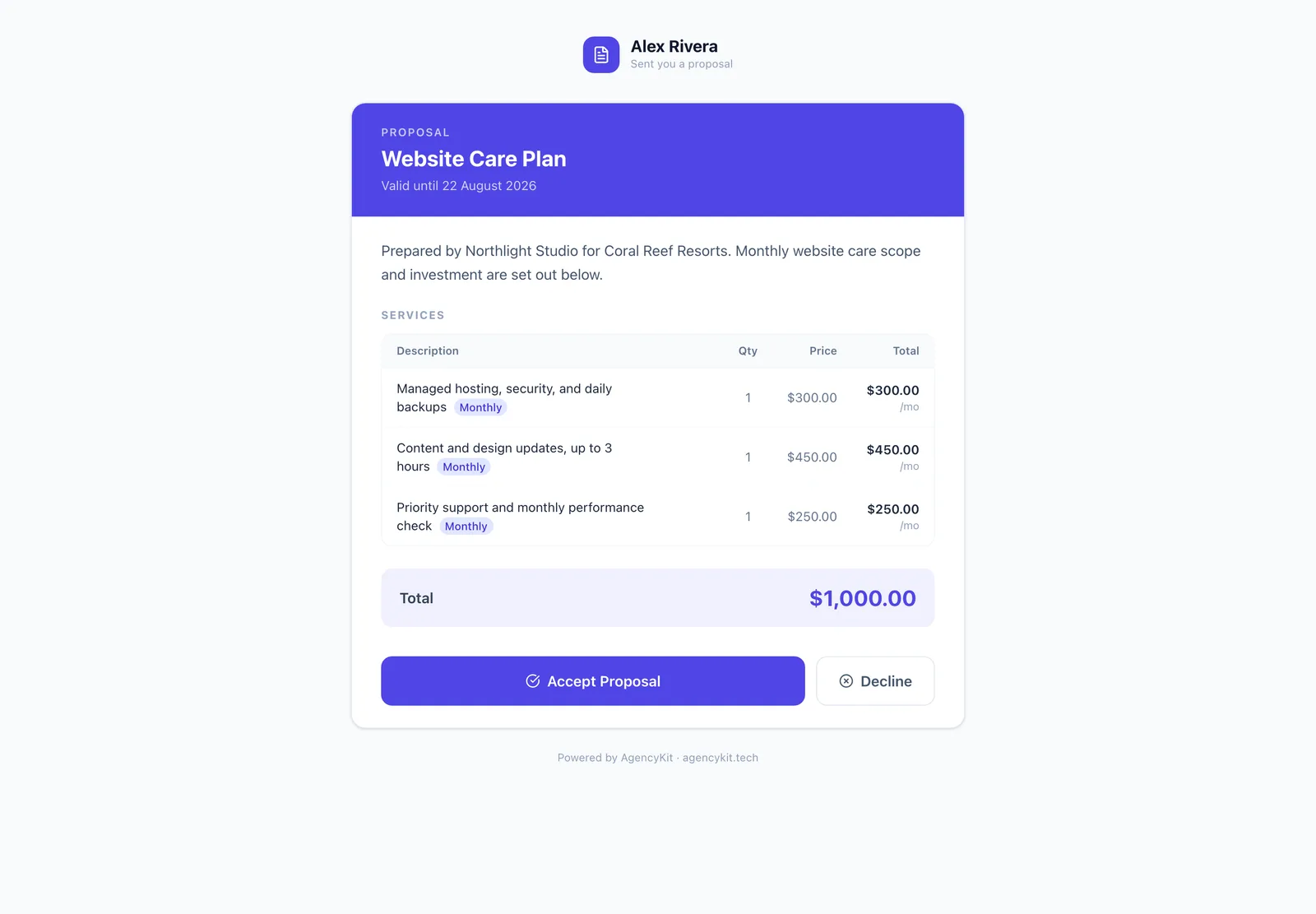
What Is a Website Care Plan?
A website care plan is a monthly retainer for keeping a site healthy after it launches: updates, backups, security, hosting, uptime, and a set amount of small changes. For a web designer or agency, it is the single best way to turn one-off builds into recurring income, and it is genuinely valuable to clients, because a website is not a "set it and finish" thing. Software needs updating, backups need running, and things break. A care plan is who they call when they do.
Where a project scope covers building the site, the care plan agreement covers looking after it. A care plan is the difference between finishing a project and keeping a client for years.
The Free Website Care Plan Template
A complete care plan agreement you can copy and adapt: The template handles the terms that matter for ongoing website support: what is included, response times, change hours, and what stays out. Replace everything in [brackets].
2. Monthly fee. [$XXX] per month for the ongoing care of [the website].
3. What is included. [Managed hosting], security and daily backups, [core and plugin] updates, uptime monitoring, and up to [3] hours per month of content and design changes.
4. Support and response times. Support requests are answered within [1] business day. Critical issues (the site is down) are responded to within [X] hours, on business days.
5. Unused hours. The monthly change hours do not roll over. Capacity is reserved for the Client each month.
6. Out of scope. New pages, new features, redesigns, and larger projects are not included in the care plan and are quoted separately.
7. Term and renewal. A rolling monthly agreement that renews automatically each month until cancelled. [No minimum, or an initial [3] months.]
8. Payment. Billed on the [1st] of each month, due [on receipt], in advance.
9. Cancellation. Either party may cancel with [30] days written notice. On cancellation, the Client keeps their website and a copy of its files, and any managed hosting is transferred or handed over.
Signed: [Agency] __________ [Client] __________ Date: __________
Offer tiers, and cap the change hours
Care plans work best as a few tiers, from a basic plan (updates, backups, security) up to a fuller one with more monthly change hours and faster response times. Whatever the tier, cap the change hours and state they do not roll over. The plan is peace of mind plus a set amount of small work, not unlimited free edits under a maintenance label.
The Terms a Care Plan Needs
A good care plan agreement is clear on a few specific points.
What is actually included. Spell it out: hosting or not, backups, security, software updates, uptime monitoring, and how many change hours. Clients need to know exactly what their monthly fee buys.
Response times. Set a standard response for routine requests and a faster one for a site being down. Response times are much of what a client is paying for: knowing someone will respond when it matters.
The line between care and new work. Small changes are included; new pages, features, and redesigns are not. State it clearly so a care plan does not slide into a free redesign.
A clean exit. On cancellation, the client keeps their site and a copy of the files, and hosting is handed over. A clean exit builds trust and makes you the agency clients recommend even when they move on.
Bill the Care Plan Automatically
Care plans are only worthwhile if they run without admin. In AgencyKit, the care plan invoices automatically each month, support requests come in as tasks, and the change hours can be tracked against the plan. Each client keeps one record with their site, plan, and history. See client management software for web designers.
Wrapping Up
A website care plan turns finished builds into steady, recurring income and keeps clients for years. Spell out exactly what is included, set response times, cap the change hours and keep them from rolling over, draw the line between care and new work, and define a clean exit. Then bill it automatically. Copy the template, set your tiers, and offer a care plan on every project you ship.
Pair it with the web design scope of work template for the build, and read what a retainer agreement should include.
Key Takeaways
- A website care plan is a monthly retainer for updates, backups, security, hosting, uptime, and capped small changes
- A care plan turns one-off builds into recurring income and keeps clients for the long term
- Spell out exactly what is included and set response times, especially for a site that is down
- Draw the line between care and new work: small changes are included, new pages and redesigns are not
- Cap the change hours, keep them from rolling over, offer tiers, and bill the plan automatically
Frequently Asked Questions
A website care plan is a monthly retainer for maintaining a site after it launches: software and plugin updates, backups, security, uptime monitoring, hosting in some cases, and a set number of hours for small content and design changes. A care plan gives the client ongoing peace of mind and support, and it gives the web designer or agency recurring income from work they have already delivered.
Typically: software and plugin updates, regular backups, security monitoring, uptime checks, optionally managed hosting, and a capped number of monthly hours for small changes. A care plan agreement should also state the response times for routine and urgent (site-down) requests, what is out of scope (new pages, features, redesigns), the term and cancellation, and the monthly fee, ideally offered as a few tiers.
The right price varies with what is included and the size of the site, so price the specific plan rather than pick a round number. Basic care plans covering updates, backups, and security often sit at the lower end, while fuller plans with more monthly change hours, faster response times, and managed hosting cost more. Offering two or three tiers lets clients choose the level of care and support they want.
Because it turns one-off builds into recurring revenue and keeps clients for the long term. A website is not finished at launch, software needs updating, backups need running, and things break, so a care plan is genuinely valuable to the client and predictable income for you. A care plan also keeps you as the client’s go-to when they eventually want a redesign or new features.
New pages, new features, redesigns, and larger projects are not part of a care plan, and the agreement should say so. A care plan covers maintenance and a capped amount of small changes, not major new work. Stating this clearly keeps the plan from quietly becoming a free redesign, and it turns bigger requests into separately quoted projects, which is better for both sides.
Usually not, and the agreement should say so. You reserve a set amount of time for the client each month, so unused change hours typically do not carry over. Stating this keeps a quiet month from becoming a demand for a big batch of work later. If you offer any rollover as a premium feature, cap it, so your monthly capacity stays predictable.
Define a clean exit in the agreement: with a notice period, commonly 30 days, and on cancellation the client keeps their website and a copy of its files, with any managed hosting handed over or transferred. A tidy exit protects your reputation and keeps you the agency clients recommend, even when they decide to manage the site themselves or move elsewhere.
A project scope of work covers building the website, a one-off engagement with a clear deliverable and an end point. A care plan is an ongoing monthly retainer for maintaining the site after launch. Selling the care plan when the build ships is what turns a single project into a lasting, recurring relationship, and it is where a lot of a web business’s stable income comes from.
Reading this in Google? You can tell it to show AgencyKit to you more often.
Sources & References
- U.S. Small Business Administration, contracts and getting paid guidance. sba.gov
- AgencyKit retainers, tasks & invoicing (2026). agencykit.tech
- AgencyKit client management for web designers (2026). agencykit.tech