What Is a Copywriting Scope of Work?
A scope of work for a copywriter is the document that defines exactly what you will write, how much, and under what terms. The scope is where "write some blog posts" becomes "four articles up to 1,500 words each, with two rounds of revisions, delivered in Google Docs." For a writer, that precision is not fussiness. A written scope is what stops a fixed fee from turning into unlimited edits and unpaid extra pieces.
Copywriting has its own scope traps that a generic contract misses: revision rounds, word counts, usage rights, and the line between writing and everything around it (design, publishing, strategy). A copywriting scope of work names all of them so both sides know exactly what the fee buys.
The Free Copywriting Scope of Work Template
A full copywriting scope you can copy and adapt: The template is built around the details that actually cause disputes in writing work. Replace everything in [brackets].
2. Deliverables. Specify each piece by type, count, and length. For example: [4] blog articles up to [1,500] words each, [1] landing page up to [800] words, [8] marketing emails up to [200] words each.
3. Research and briefing. Includes [one] briefing call and research from the Client's brief and materials. Primary interviews or extensive original research are quoted separately.
4. Revisions. [Two] rounds of revisions per piece, requested within [10] business days of delivery. Further rounds, or changes after sign-off, are billed at [$XX] per hour.
5. Formats and delivery. Delivered in [Google Docs]. [SEO title, meta description, and headline options] are [included / not included].
6. Usage rights. Full rights to the copy transfer to the Client on final payment. Until payment, the Writer retains ownership.
7. Out of scope. Design and layout, uploading or publishing, image sourcing, content strategy, and SEO keyword research, unless listed in section 2.
8. Timeline. First drafts delivered within [X] business days of a complete brief. Delays in briefs or feedback move delivery accordingly.
9. Payment. A [50%] deposit before work begins, with the balance due on delivery.
Signed: [Writer] __________ [Client] __________ Date: __________
Count the words and the revisions, in writing
The two numbers that protect a copywriter are word count and revision rounds. Without a word cap, a 'blog post' can become a 3,000-word guide. Without a revision cap, feedback loops forever. Put both in the scope for every piece, and the awkward conversations disappear.
What a Copywriting Scope Must Nail Down
A few sections are where writing work lives or dies.
Deliverables, by type and length. Do not write "content". Write "4 blog articles up to 1,500 words". Piece type, count, and word count for each. This single line is the backbone of the whole agreement.
Revisions, capped. State how many rounds are included per piece and the window to request them. Two rounds within ten business days is common. Beyond that, it is a paid extra, not a favour.
Usage rights, tied to payment. Copy is intellectual property. Standard practice is that full rights transfer to the client on final payment, and until then you retain ownership. Spell it out so there is no doubt about who owns the words and when.
The out-of-scope line. Writers get pulled into design, uploading, image sourcing, and strategy. Unless those are in section 2, they are out. Naming them explicitly turns "can you also just publish it" into a clear, separate quote.
Turn the Scope Into a Signed Proposal
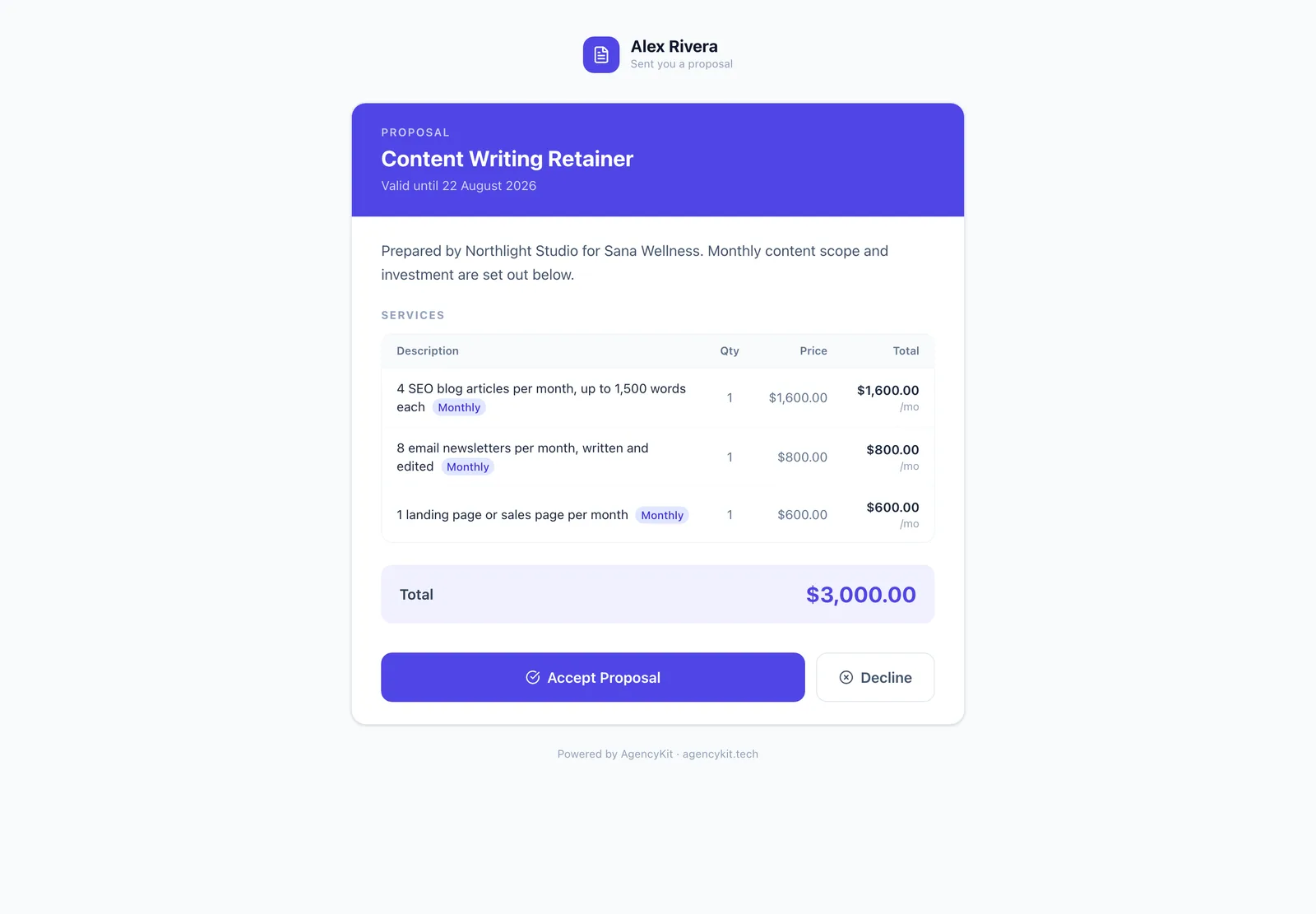
A scope only earns money once it is agreed and billing. In AgencyKit, you put the scope into a proposal the client accepts online, take a deposit, and for ongoing clients set it up as a retainer that invoices each month. Each client keeps one record with their brief and history. See our fuller guide to client management software for copywriters.
Wrapping Up
A copywriting scope of work is your defence against the two things that quietly cost writers money: scope creep and endless revisions. Name every deliverable by type and length, cap the revision rounds, tie usage rights to payment, and put design, publishing, and strategy out of scope unless you are being paid for them. Copy the template, fill in the numbers, and turn it into a signed proposal. Then you write knowing exactly what the fee covers.
For ongoing clients, add the copywriter retainer agreement template, and see how to stop scope creep.
Key Takeaways
- A copywriting scope of work defines every deliverable by type and word count, so "content" never becomes unlimited words
- Cap revisions in writing (commonly two rounds per piece) and bill further rounds hourly
- Tie usage rights to payment: rights transfer to the client on final payment, and you retain ownership until then
- Put design, publishing, image sourcing, and strategy out of scope unless they are named deliverables
- Turn the scope into a signed proposal with a deposit, or a monthly retainer for ongoing clients
Frequently Asked Questions
A copywriting scope of work defines exactly what a copywriter will write and under what terms: each deliverable by type and word count, the number of revision rounds included, usage rights, the delivery format, the timeline, and what is out of scope such as design, publishing, and strategy. A scope of work turns a vague "write some content" into a clear, priced set of pieces both sides agree to.
Name every deliverable by type, count, and word length; state the revision rounds per piece and the window to request them; define usage rights (usually transferring on final payment); specify the delivery format and whether SEO metadata or headlines are included; set the timeline; list what is out of scope; and state the payment terms, typically a deposit before work with the balance on delivery.
Two rounds per piece, requested within a set window such as ten business days, is a common and fair standard. The important thing is to cap it in writing, because uncapped revisions are the fastest way for a fixed fee to become unpaid work. State that further rounds, or changes after sign-off, are billed hourly, so extra feedback becomes a clear decision rather than an open loop.
By default the writer owns the copy they create, and standard practice is that full rights transfer to the client on final payment. Until the work is paid for, the writer retains ownership. Put this in the scope explicitly, because it protects you if a client uses the work without paying, and it gives the client the clear ownership they need once they have paid in full.
Typically design and layout, uploading or publishing the content, sourcing images, content strategy, and SEO keyword research, unless any of those are specifically listed as deliverables. Writers often get pulled into these tasks for free, so naming them as out of scope turns each request into a separate, quotable job rather than an assumed part of the writing fee.
Yes. A deposit of around 50 percent before you start protects your time and confirms the client is committed, with the balance due on delivery. For ongoing work, a monthly retainer billed in advance does the same job. Taking payment as part of an accepted proposal makes the deposit a normal, expected step rather than an awkward request after you have already begun writing.
The scope of work lists the deliverables and their terms: pieces, word counts, revisions, usage rights, and what is out of scope. The contract carries the broader legal terms: liability, payment, termination, and so on. A scope and a contract usually go together, with the scope often sitting inside the contract or the proposal. For a copywriter, the scope is the part clients read most closely.
Define it away in the scope. With every deliverable named by type and length, a revision cap, and an out-of-scope list, any extra ask has a simple answer: "That is outside our scope, here is what it would cost." The document turns "can you also write the emails too" or "one more revision" into a clear, paid decision instead of a slow, unbilled leak on a fixed fee.
The two do different jobs, and it is worth having both. The copywriting proposal template sells: the problem with their current copy, what you will do about it, and what it costs. The scope of work defines: how many pieces, how long, how many revision rounds, who supplies research and who signs off. Send the proposal first, attach the scope, and keep them as separate documents so a change to the word count next month does not mean rewriting the pitch.
Reading this in Google? You can tell it to show AgencyKit to you more often.
Sources & References
- U.S. Small Business Administration, contracts and scope guidance. sba.gov
- AgencyKit proposals, contracts & retainers (2026). agencykit.tech
- AgencyKit client management for copywriters (2026). agencykit.tech