What Is a Copywriting Retainer Agreement?
A retainer agreement is what turns freelance writing from a run of one-off gigs into steady monthly income. Where a scope of work lists the pieces you write, the retainer sets the commercial terms around them: the monthly fee, how revisions and rush jobs are handled, how usage rights work each month, and the rules for cancelling. For many writers, moving clients onto retainers is the single biggest change that makes the business feel stable.
Content work suits retainers naturally, because most clients need a steady flow: articles every week, emails every month, pages as they launch. A retainer matches that rhythm and means you are not re-pitching the same client every few weeks.
The Free Copywriter Retainer Template
A complete copywriting retainer you can copy and adapt: The template handles the writer-specific terms a generic retainer misses: revisions, rush requests, and how usage rights work month to month. Replace everything in [brackets].
2. Monthly retainer fee. [$X,XXX] per month, covering the deliverables set out in the attached scope of work.
3. Monthly deliverables. In summary: [4 blog articles and 8 marketing emails] per month. Full detail, including word counts, is in the scope of work.
4. Revisions. [Two] rounds of revisions per piece are included. Further rounds are billed at [$XX] per hour.
5. Unused work. Pieces not commissioned in a month do not roll over. The Writer reserves capacity for the Client each month.
6. Rush requests. Work needed in under [3] business days is accepted subject to availability and billed at [an additional 50%].
7. Usage rights. Rights to each piece transfer to the Client on payment of the month in which it was delivered.
8. Minimum term and renewal. [No minimum, or an initial [3] months], then continuing month to month, renewing automatically until cancelled.
9. Payment. Billed on the [1st] of each month, due [on receipt], in advance. The first month is paid before work begins.
10. Cancellation. Either party may cancel with [30] days written notice. The final month is worked and paid in full, and rights to all paid work remain with the Client.
Signed: [Writer] __________ [Client] __________ Date: __________
Tie usage rights to each month's payment
On a rolling retainer, do not transfer all rights up front. The clean approach is that the rights to each piece pass to the client when the month it was delivered in is paid. Passing rights on payment means a client who stops paying does not keep using unpaid work, and there is never a question about who owns what.
The Retainer Terms Writers Should Set
Beyond the fee, a few clauses keep a writing retainer fair and profitable.
Rollover, usually none. If a client does not commission all their pieces in a month, those pieces should not stack up for later. You reserve the writing time each month, so state that unused work does not carry over. Saying unused work does not carry over keeps a quiet month from becoming a double workload.
Rush requests. Fast turnarounds break your schedule, so price them. A clause that accepts sub-three-day work subject to availability, at a premium, lets you say yes to urgent asks without resentment, and often makes them rarer.
Revisions, still capped. A retainer does not mean unlimited edits. Keep the same revision cap per piece as a project, with extra rounds billed hourly, so the retainer covers writing, not endless rewriting.
Notice and rights on exit. Thirty days of notice protects your income, and a clear line that rights to all paid work stay with the client on cancellation makes the exit clean and keeps your reputation intact.
Bill the Retainer in Advance, Automatically
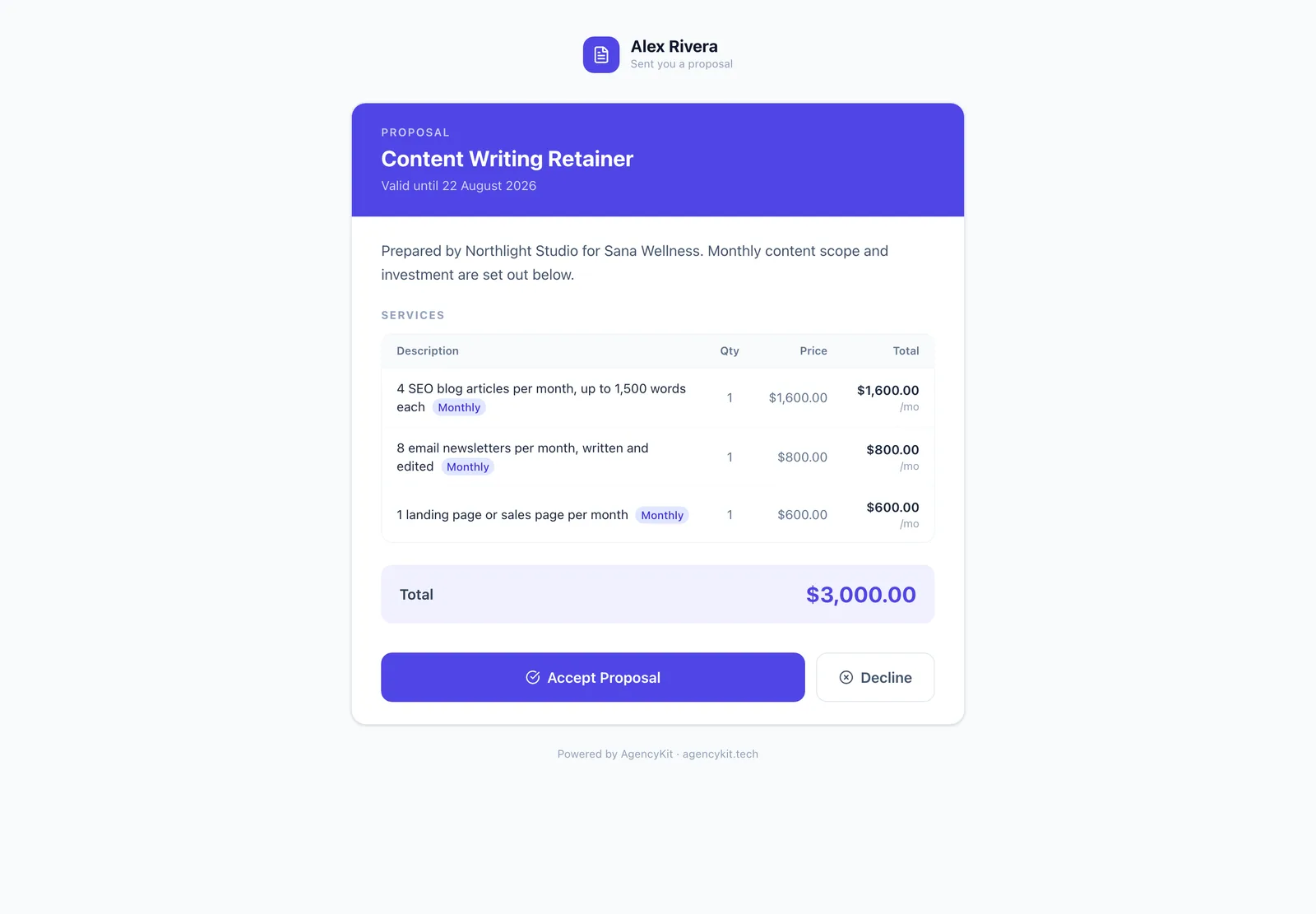
A writing retainer should pay you predictably, so bill it at the start of each month, before the work, and automate it. In AgencyKit, the agreed retainer invoices automatically on the same day each month, and each client keeps one record with their brief, pieces, and history. See client management software for copywriters for the full setup.
Wrapping Up
A copywriter retainer agreement is what makes freelance writing feel like a real business: predictable income, clear terms, and clients who stay. Set the monthly fee, keep the revision cap, decide that unused work does not roll over, price rush jobs, and tie usage rights to each month's payment. Then bill it in advance and automatically. Copy the template, set your terms, and turn your best clients into steady monthly revenue.
Pair it with the copywriting scope of work template for the deliverables, and read what a retainer agreement should include.
Key Takeaways
- A retainer agreement sets the commercial terms (fee, revisions, rush, cancellation) while the scope of work lists the pieces
- Keep the revision cap per piece: a retainer covers writing, not unlimited rewriting
- Unused pieces usually do not roll over, because you reserve writing capacity each month
- Price rush requests at a premium so urgent asks do not wreck your schedule or your goodwill
- Tie usage rights to each month’s payment, and bill the retainer in advance and automatically
Frequently Asked Questions
A copywriter retainer agreement is the document that sets the commercial terms of ongoing writing work: the monthly fee, the deliverables (usually in an attached scope of work), the revision cap, how rush requests are priced, whether unused work rolls over, how usage rights transfer, and the cancellation terms. A retainer turns a run of one-off gigs into a steady monthly arrangement with clear rules on both sides.
The client pays a set fee each month, usually in advance, for an agreed set of deliverables such as a number of articles and emails. The writer reserves capacity for that client monthly. A scope of work lists the exact pieces and word counts, while the retainer agreement handles the fee, revisions, rush requests, usage rights, and cancellation. A copywriting retainer gives the writer predictable income and the client a reliable content flow.
The right fee depends entirely on the deliverables, so price the specific pieces rather than pick a round number. Content retainers commonly range from a few hundred dollars a month for a light package up to several thousand for a full content program. Base the fee on the number of pieces, their length, and the research involved, all set out in the scope of work the retainer refers to.
Usually not, and the agreement should say so. You reserve writing capacity for the client each month, so pieces they do not commission typically do not carry over to the next month. Stating this prevents a quiet month from becoming a demand for double the work later. If you allow any rollover, cap it tightly, for example at one month, so your schedule stays manageable.
Price them into the agreement. A clause that accepts work needed in under a few business days, subject to your availability, at a premium such as an extra 50 percent, lets you say yes to urgent asks without wrecking your schedule or your goodwill. A published rush rate also tends to make rush requests rarer, because there is a clear cost attached rather than an assumption that everything is urgent.
The cleanest approach on a rolling retainer is that the rights to each piece transfer to the client when the month it was delivered in is paid, rather than transferring everything up front. Passing rights month by month protects you if a client stops paying, since they do not keep using unpaid work, and it keeps ownership unambiguous month to month. On cancellation, rights to all paid work remain with the client.
It is optional and depends on the work. Some writers use a short minimum term, such as three months, so a client commits long enough for the arrangement to be worthwhile, while others run purely month to month with a notice period. Whichever you choose, include a clear cancellation clause, commonly 30 days notice with the final month worked and paid in full, so the exit is orderly.
Bill it in advance, at the start of each month before the work, and automate it so you are not raising invoices by hand. Set the retainer to invoice on the same day each month. In an all-in-one tool the agreed retainer invoices on schedule and each client sits in one record with their brief and pieces, so getting paid becomes predictable and hands-off rather than a monthly chase.
Reading this in Google? You can tell it to show AgencyKit to you more often.
Sources & References
- U.S. Small Business Administration, contracts and getting paid guidance. sba.gov
- AgencyKit retainers & recurring invoicing (2026). agencykit.tech
- AgencyKit client management for copywriters (2026). agencykit.tech